Monday, November 25, 2013

Taking advantage of conditions

The Mendocino coast is known for its dynamic water. Miles of rock gardens filled with pourovers and slots, surf breaks around every corner, and lots of large swell to fill it all up. But every once in a while the swells go away. We're left with nearly flat ocean conditions. And when it's also sunny and calm, you need to take advantage of it.

This past weekend we had short period swells under three feet. That translated to less than a foot of surf in on some of the beaches. So it was time to explore places you can't normally get to, and time for even the timid to start playing around the rocks.

On Saturday we went to Russian Gulch with a group of friends from the Sacramento Sea Kayakers. Most people were in short boats - some for the first time - and we got the chance to play around the outer rocks. Heading north towards Caspar is a series of tunnels and arches that allow you to explore while being protected from the swells. That protection comes from a line of outside rocks and take the energy of the day. Since this day had such little wave energy, we could actually explore the outside rocks, going wherever we wanted.

We still found some nice pourovers and slots. The occasional bigger set would come through and give everyone a little ride and excitement, but it was always gentle and forgiving. I was even able to climb out on the rocks to get some closeup shots.We didn't go very far, but it was a lot of fun.

The next day we went further south. We left the short boats and took our sea kayaks to Navarro. The beach  is steep and dumpy, but with one foot waves it was an easy launch. After Cate dropped some crab pots we headed down towards the town of Elk, playing in every nook and cranny along the way.

And there were lots of nooks to explore. Lots of tunnels that went through to secret lagoons, lots of caves that disappeared in darkness, and more rocks to paddle around then we had time for. There were multiple rocks with multiple arches and again, plenty of sunshine to see it by. The visibility in the water was just as good, and almost the whole time we got to watch the garden of the sea pass under us as we made our way along the coast. It's a beautiful stretch and normally requires a lot of work to reach, but this day was a walk in the park.

We finished the weekend with some fresh caught abalone (thanks, love!) and lots of gear cleanup. I'm sure we'll be getting more winter storms soon, and we'll enjoy the surf and excitement that comes with them. But it will be nice to hold the memory of a warm, flat weekend and the special places along the coast that are seldom visited.

More pictures of Russian Gulch HERE. Navarro to Elk HERE. And finally, after some delay, here's the video of the trip from Navarro to Elk:

Sunday, November 3, 2013

Kayak Paddle Review - non specific

My gear reviews tend to get a lot of hits. That makes sense - people like to know what others think of specific gear. But the truth is, most people don't try to understand enough about gear in general. Instead of wondering if the Werner Shogun is the best paddle ever, you would be better off understanding how the different paddle attributes relate to what you paddle, how you paddle, and your goals as a paddler. So in that light, I want to talk about paddles in general (with some specific examples) so that people can make their own decisions instead of worrying so much about what other people think.

Like all paddling gear, paddles have competing characteristics. What makes it good at one aspect of paddling is exactly what makes it bad at another. So understanding what you want in a paddle is the first step in getting the correct paddle. I'm going to stick with the basics and the more common Euro paddles - I'll leave Greenland sticks and Wing paddles for another time.

Let's start with size since everyone know's that's what really matters :). Paddles come in different lengths. In general, taller people will want longer paddles. But ideal size depends a lot on technique and type of paddling. For dynamic paddling, whether in the ocean or on the river, most people use shorter paddles. Shorter paddles work better with more vertical strokes (which give more power but also use more energy). Longer paddles give more leverage and work better with lower angle technique. Shorter paddles give quicker acceleration while longer paddles often work better for maintaining speed. Bigger is not always better.

[I'm 6' tall with the same arm span. I use a 220cm paddle for touring, anything where I'm going to cover lots of distance and use mostly forward strokes. On the river I use a 197cm paddle. When I play in a sea kayak I use a 205cm paddle - sea kayaks often sit you up higher and don't respond as quickly as a WW boat, so the extra length helps out with leverage. For surfing I have a 193cm paddler, allows for a faster turnover rate and quick acceleration. For polo I use a 200cm paddle - it balances acceleration with the ability to block the goal if necessary.]

The other main size consideration is the blade size. I think most people use blades that are too large. A large blade really anchors in the water and it often feels like you get a good grip. But unless you have a lot of strength, or a lot of weight you need to push, that large blade is going to be much harder to pull on. It will accelerate slower and strain your body more. Don't judge a blade on how a few strokes feel - paddle with it for a day and see how your body feels at the end. Again, bigger not always better.

[I use a moderately large WW blade - I'm fairly strong and paddle a lot. I use a medium blade for most sea kayaking and a smaller blade for surfing. I don't have a lot of weight to pull through the water (170 lbs.) so I don't need the largest blades out there, even though I have the strength to use them. I can accelerate quicker and feel better using a medium blade for most things. I like a larger blade on the river so I can get max power out of it on those few occasions where it's really necessary. But I don't need it when teaching or running class IV or lower.]

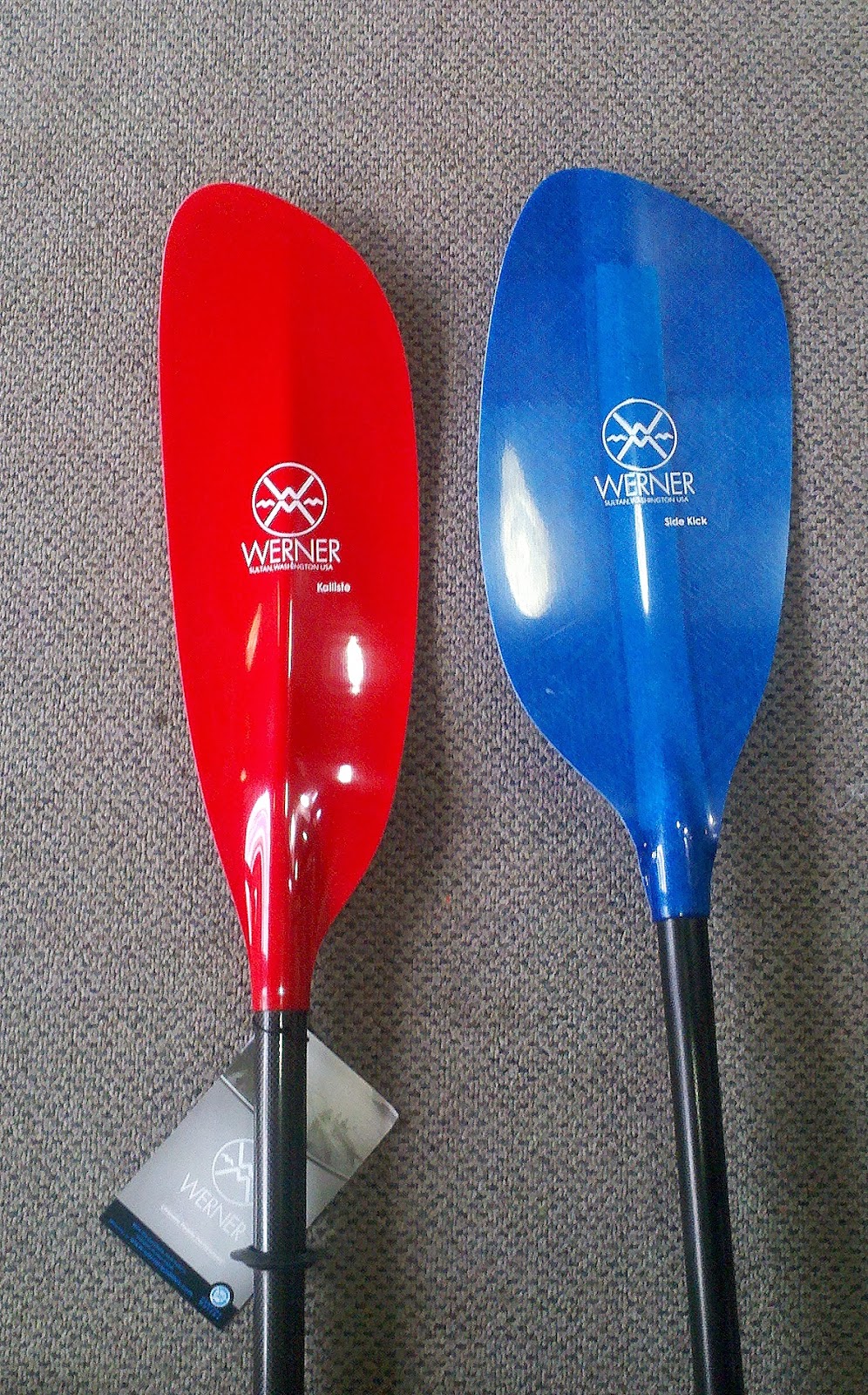
left: low angle touring
right: downturned whitewater
There's also the blade shape to consider. Blade shape should match your paddling style and technique. The simplest way to break it down is that long and skinny blades work for low angle paddling, while shorter, fatter blades work for high angle styles. There has been a big trend for sea kayakers to use high angles paddles, especially those paddling more dynamic water. But the truth is that most of those people, most of the time, are still using a low angle paddling technique. Some paddles work okay for multiple angles, some are more specific in where they work. In whitewater it's almost all high angle designs, with the added option of downturned blades. Downturned blades come from the slalom world and work well for folks with good technique and very high angle strokes. To each their own.

[I like downturned blades for whitewater and surf - I have fairly good technique with lots of verticality in my strokes. For long distance paddles I definitely am a low angle paddler so I like a longer, skinnier blade.]


Paddles also come in different materials and different weights. The most important thing to understand is that lighter paddles are not as strong as heavier ones. You'd think that would be obvious, but people who snap ultra lightweight sea kayak paddles when playing among the rocks always seem so surprised. There's a reason that whitewater paddles weigh 50% more than sea kayak paddles in spite of being smaller. Carbon does give you a lighter weight for the same strength when compared to fiberglass, but it's also stiffer. A stiffer paddle can be more responsive but it also puts more stress on your joints. Wood is generally heavier than composites, but it also has more flex, more buoyancy in the water, and feels warmer in cold weather. Plastics are heavy and flexible, often to a degree that really impedes their performance. But plastic can be very durable and inexpensive, characteristics of importance to some folks. Lighter isn't always better.

[I use mostly carbon paddles. As I'm getting older (aren't we all) I find myself shifting away from the peak performance to find things that are easier on my body. I now use a wood shaft/carbon blade paddle for ocean play and will probably switch to that on the river soon. I use a light weight carbon paddle for touring and don't expect to change that - those ounces really add up over long distances.]

Top to bottom:
partial; full foam, no foam
Another material question is foam core blades. Foam cores give paddle blades more buoyancy and that results in a lighter swing weight (what you feel while paddling). They can also help (minimally) when rolling or bracing in aerated water. But the thicker blade does have a different feel in the water - I've found that they don't 'grip' as well until they're fully submerged. That's not an issue if you have good technique and are taking purposeful strokes, but that's not always the case in real dynamic environments. The other thing to be aware of is that foam cores are not quite as tough as solid composites - they can be punctured and while they are stiff they lose a little strength. Pick your poison.

top: foam core; bottom: plain carbon
[I now use a full foam core blade on whitewater and it took some getting used to. I appreciate the extra buoyancy and can still get what I need out of it but I have to be a little more careful to use good technique and fully engage the blade. For ocean play I use a partial foam core that has a thinner edge like a traditional paddle. I really like the combination of a little extra buoyancy with a nice sharp bite on the edge. I think foam core is the way to go for touring but the worries over durability have kept me away from them since I tend to to end up using my gear hard no matter what it's purpose.]

Between the blades lies the shaft. Lets talk about straight vs. bent. The idea behind bent shaft paddles is to put your wrists in a more neutral position. That's undoubtedly a good thing. If you have wrist or forearm problems, the bent shaft can reduce strain and ease carpal tunnel syndromes. But some people don't need it. A straight shaft is lighter and stronger (and cheaper). The main thing to know is that switching from one to the other will take some adjustment time. Give yourself several paddles to decide what works best. And realize that not all bent shafts are the same - some just feel better than others. Test 'em out to find your fit.

[I always try to use bent shaft. I paddle a lot and I type even more, so my wrists/forearms get a lot of stress. Bent shafts make a noticeable difference for me. The only straight shaft paddles I use are in polo - just too much moving the hands around and doing other things with the paddle to make a bent shaft work.]

Finally, lets talk thickness. My thoughts have evolved on this. Standard thought is that smaller hands should use a thinner shaft - less strain on the hand. But I had an interesting discussion with a paddle designer who said the research says there is less muscle strain when hands grip an object that fills up the hand compared to smaller diameters. After trying his paddle for a couple days (it being thicker than what I'm use to) I had to agree. I was surprised, but I actually felt less fatigue. This is another instance where first impressions often fail - the larger paddle always feels a little awkward when I first grab it, but after a few minutes of use I forget about it and at the end of the day my hands feel better. Don't be afraid of the large.

[I mostly use standard size paddle shafts even though my hands are on the small side. My newest paddle has a thicker shaft and I love it. One of my polo paddles has a thinner shaft and it always gave me more grip fatigue issues but I figured it was from the hard use or the straight shaft. I think I'll stick to thicker shafts from now on.]

There is more to talk about with paddles, more material/shape/swing-weight issues. But I've rambled enough. This should get you started. If you have any specific questions on paddle design please leave it in the comments. If you're curious, others out there will be as well.
Monday, October 28, 2013

Hardcore sea kayaking - or not

Looks hardcore but really just got left behind when the wave receded.
I had a student recently who said that he was interested in joining the local paddling club but he wasn't ready. He said they were hardcore. I held back my laughter. But it was funny on many levels.

First, this was in an advanced class - rough water rescues. The student in question had solid rescues - quick T rescues and scrambles in confused four foot swells bouncing off rocks. That puts him far ahead of many club members and many experienced paddlers. He also had a roll. Not completely reliable yet, but a solid roll that worked when he needed it. I know quite a few paddlers who venture out on the ocean in fairly rough conditions without knowing how to roll. Once again, my student was well ahead of the game.

Second, the club isn't really hardcore. I've never seen a club that is. That isn't to say that there aren't some very skilled paddlers in the club, and some that do gnarly paddling. But clubs always consist of a wide variety of paddlers. I would venture to say that the majority of any sea kayaking club are people who go no further than well protected ocean paddler. Many never experience swells. And that's great - there's so much beauty, fun, and variety to be had on flat water paddles. Any club that has open membership is going to end up with a range of members and that diversity means the club as a whole is not hardcore. Individual members may vary.
Looks cold but the air temp was 50 deg. and we had dinner at a nice restaurant after.

The third reason the statement was funny is that hardcore is a silly term. What's it mean? Do you have to paddle near rocks? Or in really big waves? Does it mean you launch before dawn? Or does paddling without any chocolate count as hardcore? Everyone's going to have a different opinion and all of them are valid so all of them are slightly meaningless. We can probably agree that circumnavigating Australia is hard core. Anything less becomes arguable.

In the end I highly encouraged my student to go ahead and join the club already. Like most paddling clubs, it's filled with friendly people of all levels who enjoy new members. Joining a club is a great way to meet people at your level and it's a great way to start paddling with people at a higher level - that's how you improve. Hardcore is not a prerequisite and isn't even a goal for most people. Clubs wouldn't survive if they didn't welcome newcomers and transfer knowledge.

The wave is all foam and dies out in ten feet.
So why are so many people intimidated by clubs? My student is not the first to express this opinion. It often comes from the fact that the most experienced members of a club are often the most socially active on forums/message boards/email lists. Everyone likes to talk about their biggest and baddest adventures. Or talk about other people's big, bad adventures. It skews the chatter away from being a true representative of the club and the sport in general. And I think it's getting worse.

While this 'hardcore' talk is natural, and everyone wants to excel in their sport, I think the mindset of many folks is a bit off. I've seen more and more people getting into rock gardening, more people getting into rough water play. I think that's great. But it's not necessarily hardcore. To be honest, it often isn't even advanced paddling. It's fun. Some of it requires good skills. But lots of it just requires solid rescue skills (which should learned early on in one's paddling career) and good judgment. I've seen plenty of people doing 'hardcore' stuff who have limited skills and experience, sometimes even limited judgment. I don't think that makes you hardcore.

Those of us who enjoy rock garden paddling, especially those with advanced skills and lots of experience, should be more aware of the perception we create. Without meaning to, we can easily disregard the other aspects of the sport in favor of our exciting stories. I know I talk about my adventures a lot - right here on the blog. But I also write up my flat water paddles. I also share the simple things I do. I celebrate all levels of paddling and appreciate those who don't want thrills but merely enjoyment. I know quite a few truly hardcore paddlers and they feel the same way. The 'hardest' paddlers out there tend talk up the fun and play down the danger.

As easy as it looks.
So if you want to be hardcore, that's okay. But the next time you post to your club or talk to a beginner, let them know that's it's also okay to not be hardcore. In fact, maybe even go out of your way celebrate easier paddling. Sea kayaking means many different things to different people. What's important is that people are having fun, doing it safely, and no one is left out. Hardcore or not.


Wednesday, October 23, 2013

Lumpy Waters 2013

Once again, the Lumpy Waters Sea Kayak Symposium put on by Alder Creek was an incredible event and tons of fun. You never quite know what you're going to get for weather in mid October on the Oregon coast, but this year was better than anyone could have imagined. Last year had rain, wind, big swell, and cold temperatures (read about it HERE). This year was sunny and warm, mostly light breezes and small swells. Perfect teaching conditions.

This was also the first year that I ended up teaching what I was assigned. There were the usual changes - students switching classes, class offerings changing to suit the conditions, instructors moving around to cover things - but I somehow escaped all that. It was nice to be able to follow through on my game plan for once.

On Friday I taught an edging and bracing class with Rob Yates. With the smallest swells of the weekend, we  were able to get right into the surf zone and have the students practice the skills in the environment where they'll need them. Rob had folks working without paddles and the instructors took turns standing chest deep in the cold water while the students practiced going in and out and doing some side surfing. Everyone was nervous at first but by the end they felt almost more comfortable bracing without a paddle than with it. Lots of smiles all around.

On Saturday I taught a rescue class and then an intro surf zone class. We didn't really have much rough water for the rescues but the plentiful sunshine allowed for lots of in water practice and people came away with some new ideas and a couple a-ha moments. The surf zone was great with more swimming and playing out of the boats to get used to the waves. The students got in their boats while once again the instructors stayed in the water to assist. Everyone did a great job at holding position and going in and out of the surf. Everyone also had a good wipeout while trying to surf - good to learn how to handle that early on since crashing is a big part of surfing.

On Sunday I got to stay in my boat for an Intro to Rock Garden Safety class. Some students were tuckered out from the previous two days and called it a weekend early, so we ended up with almost as many instructors as students and divided up into two groups. We paddled out of the Salmon River mouth to play at Cascade Head - truly one of the most beautiful spots on a very beautiful coast. We had to get through some breaking waves on a sand bar and my pod made it fine. Several other classes did as well. But the other group of Intro students had the misfortune of hitting the biggest set of the day. A boat on boat collision led to some carnage and a number of swimmers. Everyone was okay and they regrouped on shore and decided to stay inside. My gang got to work around the arches and explore a deep cave before heading back in on a higher tide that created gentler surf. We stopped at the beach for a well deserved break before the flat paddle back to the launch.

I enjoy teaching at these symposiums but another reason I love to go is to catch up with friends. It was great to see my Pacific Northwest friends like Paul Kuthe, Matt Nelson, Shawna and Leon, and others. I even got to catch up with some of my California friends who are a little farther away now that I live in Fort Bragg. It even seemed like I needed to catch up with my neighbors Jeff and Cate since they've been working so much lately we haven't had time to go out and play. It all went by too quickly but I know we'll do it again next year (Oct 10-12, 2014). In the meantime, it's time to start thinking about the Golden Gate Sea Kayak Symposium in January.


Thursday, October 3, 2013

Kayak Polo - U.S. National Championships

I used to play kayak polo rather seriously. In fact, it pretty much became the only paddling I did. That was back in 2006 when I was on the U.S. National Team and preparing for the World Championships. It was at those championships that I hurt my shoulder and after which I decided to retire. I also moved to a location that didn't have any kayak polo so giving up the game was a de facto necessity as much as a choice. But every once in a while I find a good reason to come out of retirement and play a little polo.

This year San Francisco hosted the National Championships for the first time. It's close enough to make it a long weekend trip without a lot of expense. I knew I was going to go but wasn't sure who I would end up playing with. I starting training (a little) and doing some boat repair (a lot). I wasn't sure what to expect.

The weekend started on Friday with a one day 'Open' tournament. The Championship is for U.S. clubs and there are rules that govern who can play (have to be living in the U.S.) and how teams can be formed (you can't form an all-star team from different cities). That's as it should be, but it's a shame to waste a chance to play high level polo when the best players in the country are all going to be in the same place. Not to mention some of the best players from Canada who come down looking for some good competition. So the Open division is designed to allow any teams to enter. This year there were four teams: the U.S. National team; a Canadian all-star team; a New York squad who all just flew out a day early for some extra California sun; and a mixed team of former and current U.S. Squad members (that would include me).

My Open team had some experience going for it and we also had some youth on our side. But we didn't have any subs and we had never played together. I hadn't even met one of the guys before we suited up. And we started against the Canadians who we all expected to be the top team. But it turned out that we won the game. Rather handily. Won the next one, too. We ended up winning the whole division by playing some great team polo. It was great to find a group that worked so well together without a lot of time or practice. No drama or fighting, no one hogging the spotlight or trying to be the big man. Just good, honest teamwork. It was one of the funnest days of polo I've had and the result was just the icing on the cake.

The next day was the start of the club championships and it was a completely different team and different competition. I would once again be representing the UCLA club that I had been a member of when it was first formed back in 2001. Even though I no longer lived anywhere close, without a local team I was allowed to play with my old club under the tournament rules. Many of my previous teammates were still around so we tried to put the band back together. We couldn't get all of the old guard but instead recruited some new blood. Always a good thing in the long run but it creates some doubts for the present. Can we gel in time? Are the newbies over their heads? Are the old timers just plain old? I really wasn't sure how it would go.

This time we started against New York who had some strong players but wasn't expected to be challenging for the title. We planned on keeping things simple and played conservatively as the new guys who hadn't played in the Open division got their legs under them (so to speak). We came out with a win and were feeling pretty good. It didn't last long. Our second game was against Austin, the two-time defending champs, and they thrashed us pretty good. Our lack of experience together and some fitness issues were evident. But the most important thing was that we stayed tight as a team. Everyone took responsibilities for their mistakes (we all made them) and everyone was supportive of each other as we got ready for our next game.

UCLA Men (l to r): Me, Ge, Danny, Patrick, Rob
The Canadians were next. The same team that had finished second in the Open division, but with the addition of another strong player. We just wanted to play a good game but didn't have any high expectations. But that teamwork vibe that brought us together after our loss now held us together during the game. Facing younger, stronger, more skilled players we worked together to hold them off and fought them to a tie. It would turn out to be the only game they didn't win in the tournament.

We had one more loss, then one more win and one more tie. At the end of the round robin play we were tied with Carolina for third - only the top three advanced and Carolina had the advantage over us in goal differential so they moved on while we were done. Once again, UCLA finished off the podium. But I have to say that I was very happy with the tournament. While the result in the Club division didn't match that of the Open, the fun was in the attempt. We played as a team, we played good polo, we did as well as could be expected against strong competition. It was the tightest Nationals I've been at and we were right in the mix. That's all you can ask for and it's enough for me.

Now that it's all over, I'm back to being a retired kayak polo player. My shoulder survived the weekend but it didn't enjoy it at all. My recent move has also put me even further from any club to play with. So I'll go back to the ocean and the rivers. But I'll keep the polo gear clean and ready for the next occasion that pulls me back in.

And congratulations to all the winners at the U.S. Kayak Polo National Championships:
Open: USA 1 (my team)
Club A: Austin Aquabats
Women: Unstoppable Unicorns (mostly California girls)
Club B: Bat Shot Crazy (I think from Texas)

If you have no idea what kayak polo is like, this is a little introductory video:


And here's some action from the 2009 U.S. National Championships: