Saturday, June 13, 2020

My Journey on Race

I often get a little introspective about kayaking on this blog. I believe that reviewing what we've done and learned in the past helps us learn more and make better decisions in the future. This is true of life as well as paddling and sometimes the two intersect, sometimes life seems more important than paddling. In this current moment of increased attention on the Black Lives Matter movement, with hundreds of thousands of people demonstrating in the streets to fight for justice, I think it's important we all take the time to reflect on ourselves. Who we are. How we got here. What role we play in society and what we can do to help others, whether they are paddlers or not. Because the kayaking community has a great tradition of helping its own, but who gets to be in our group reflects manner of the same prejudices and disparities as the rest of the world. If nothing else, let's increase our awareness of that reality.

[1970’s] I grew up a white boy in a white farm town in Minnesota. There was literally one Black kid in school. The only other Black people I saw were on TV. Race wasn’t an issue because it didn’t seem to exist. Racism was an abstract concept, like an alligator, or monsoon. I was happy in a selfish way like all children should be. That isn’t to say it was ideal. Far from it. My lack of personal interactions with People of Color made them something foreign. Not to be feared or looked down upon - my parents made it clear everyone was inherently worthy of my respect and friendship regardless of their skin color - but simply something unknown. And if you don’t know something it’s hard to care about it.
[1980’s] When I got to a larger high school which was slightly more diverse, I was still surrounded by whiteness. I took AP classes and played on the tennis team - no People of Color so no racism to be found (I’ve later learned how absence can be the best proof of existence). By this point I realized some people were racist, but it seemed like an isolated, individual thing. Not my concern. My social studies and history classes taught us the evils of slavery and segregation, but they were clearly THINGS IN THE PAST. So much real history and current events which would have revealed a darker, less flattering picture of my country and peers was left out without comment.
MOVE Bombing in Philadelphia
I’m not sure how much the lack of color in the student body directly related to the slant of the curriculum. I’m sure some, but I also think the historical failings of America are always taught as someone else’s fault - for us we were the good northern whites, for others they were the noble southerners who opposed slavery but revered states’ rights. Whatever the excuse, nothing and no one ever really opened me up to the perspective of the marginalized and oppressed. All my education came from white people and was geared to assuage White Guilt. At the time it seemed simple truth. Only a sheltered high school kid would think truth was simple.
[1990’s] After growing up in a small town, I moved to the big city of St. Paul for college. A liberal school with a large international population nestled in among old mansions and a growing Hmong community. Much more diverse than where I grew up, but not in a representative way. My dorm neighbor freshman year was a Black guy from Chicago. He was also wealthy, came from an elite private academy, a hell of a sharp dresser and made the ladies swoon. He seemed better off than me. I studied physics and continued playing tennis and was mostly surrounded by white people much like myself. The one Black kid on the tennis team had grown up around the world with diplomat parents. He had attended famous tennis academies, had private coaches, and was the #1 player on the team whereas I was a scrub on the bench. He wasn’t my equal - he was my better. Racism didn’t seem to have had much effect on those around me. Of course, this wasn’t true. I never really bothered to learn the whole stories of those two gentlemen, or any of the other People of Color at my school, but in retrospect I’m sure they faced all kinds of challenges which would have stopped me cold. I failed to grasp that perhaps the reason why those Black students seemed so exceptional was because it took exceptional circumstances and character for them to make it to the same place where my generic, middle-class, white-ass education had brought me. A same result isn’t proof of similar ability if the testing conditions aren’t equal.
Rodney King Beating
Graduate school brought me to Los Angeles, a more diverse city overall but not necessarily where I landed. My physics program had no Black students or instructors and campus was across the street from Bel Air. While the neighborhood had many more shades of brown, it didn’t have much Black. For the most part everyone I knew seemed colorblind and accepting of others and there just wasn’t any pressing need for me to look beyond my own experience. After graduate school I eventually landed in middle management in a private education company in the same neighborhood. I was in charge of hiring instructors and part time staff and I never once considered race when interviewing. I made decisions based on experience and credentials - and gut instinct. Let’s not forget that every hiring manager knows they have to trust their gut when considering candidates. I didn’t really consider how my ‘gut’ always seemed to favor people who looked like me and came from similar circumstances. Those with a shared community and vocabulary. But I wasn’t racist, so that was fine, right? Implicit bias is a hell of a drug. Looking back I think my track record on dealing with the people who showed up for jobs was fine. But I never really questioned exactly how those people made it in the door and why so few Black people even applied. I certainly never did anything to expand our pool of applicants. I never did any outreach to the Black community or sought to make our company’s services more readily available to the disadvantaged. We helped people get into schools, but only if they could afford us. That’s capitalism and I was there to make money for the company. I never looked at how centuries of systemic racism, redlining, school segregation, and just plain racist people have greatly limited wealth and economic opportunity in the Black community. I looked at what was in front of me and tried to treat everyone equally without stepping back to see the inequality which starts at the beginning of every Black life and which I perpetuated. Making society better, more fair, was extra work and no one paid me to do it so I didn’t even think of the option. It’s so easy to be a good guy in a bad system as long as you aren’t the one being harmed. [2000’s] Nearing my thirties, working in middle management for a company focused on helping mostly the privileged, and with lots of opportunities for advancement - I bailed on my career. Capitalism wasn’t my thing so I pursued my new sport: kayaking. If anything, kayaking is whiter than the tennis I had played in high school and college. Kayaking became my job (instructor), my hobby, and my source of friends and acquaintances. All white. My holdover connections from the past were overly educated white people or tenuous connections to my childhood white farming community. I didn’t have any personal connections to the Black community or any compelling reason to learn about it.
President Obama and Birtherism
A solid decade of pursuing my self interest led to very little interest in the rest of society. But it’s not like I wasn’t aware. The internet really changed how information came in, and even before our current overload of social media it was impossible for me not to soak up what was happening in the rest of the world. It was impossible to live in society, interacting with others, catching snippets of the news, having small talk with random people, and not see the truth. In politics, social justice, economic welfare, racial equality - they were all a hot mess where those with advantage used it to take more advantage. Inequality, discrimination, and injustice were everywhere and obvious and I no longer wanted to be a part of such a stupid and cruel system. I bailed on society. Of course, that’s perhaps the greatest example of privilege there is. I had the resources to do nothing but eke by a meager living and spend only on myself. The freedom to ignore the evils of society because they weren’t visited upon me. Some years I technically lived in poverty, but I never felt poor. I was a well-educated white guy and if I wanted to make money I could always get a job. If I really needed something I had family and friends who would help me (and could afford to). It wasn’t that I had done anything special to have such resources available. Just by who I was born to and how my skin color had smoothed my way through life, flowing around obstacles and intermingling with other like-colored individuals, I accumulated a vast wealth of social capital that allowed me to step away from any responsibility to anyone outside my insular bubble. I could afford to be selfish. The world doesn’t give that same opportunity to everyone and eventually I’d have to confront that fact.
My Paddling Memoir
[2010’s] My life changed in many ways when I hit my forties and decided to turn my hobby of writing into a new career. I studied the craft of writing, and that included reading widely and listening to different voices. In the past, the stories I read were often centered on straight, white, male heroes. People like me. And the authors who wrote those stories were usually the same. As I branched out, I discovered so many new stories and perspectives. So much wonderful talent and humanity. And if I wanted to write more than self-insert hero fantasies, I needed to understand and appreciate the full diversity of real-world people in order to bring it to my characters and books. But what started as an effort to improve my work became a chance to improve myself. Fiction tends to hold the truth up in a way that makes it clearer than reality. It also led me to many great people who happened to be authors of color. I became aware of marginalized communities as individual people, and once you start to see people it’s hard not to listen to them. And I heard the same stories of discrimination and prejudice over and over again. Black kids who had no access to decent textbooks, much less AP courses. Black authors who continually get praised for speaking so well, as if it’s a surprise someone with their skin color can be eloquent. Black physicists who still get mistaken for waiters when they show up at a fancy dinner in a tuxedo. In a myriad of ways, in every aspect of life, the experience of being Black in America was so much different from my own, with so many more obstacles that no one should have to overcome.
Racial Disparities in Wealth
But those were just stories. Still a scientist at heart, I wanted data. I read articles and books, both scholarly and journalistic. I followed modern Black activists and learned more about their predecessors. I paid attention to the details. What I found didn’t just confirm the stories but expanded on the injustice in deeper ways. From the implicit bias which makes white educators look at Black children as more responsible for their actions compared to white kids, and white doctors believe Black patients are more pain tolerant so they under-prescribe painkillers. To the explicit bias of racial profiling in everything from traffic stops to mortgage loans. I learned about redlining and how our capitalistic system allowed the white people with money to force segregation upon Blacks while making a profit from it (segregation which is actually getting worse today). I learned about the Tulsa massacre, the MOVE bombing in Philadelphia, and the Jon Burge scandal in the Chicago PD. I learned how the Black Panthers started the idea of free breakfasts for school children while the FBI worked hard to get them killed. Through it all I found statistic after statistic that showed Black Americans were behind in nearly every measure of success, from wealth to health, from crime to education, and even in simple human respect. And if Black Americans are behind, the obvious question is why? What could explain such discrepancies? I could only come up with two general answers: 1. Systemic racism. If our society has a racial bias that exists in the majority group, the ones who currently hold, and have always held, wealth, power, and influence, then it would create an uneven playing field which would result in unequal results. 2. Black people are somehow inferior. Whether it’s genetics or culture, it would take some across-the-board fundamental deficiency in Black people to explain why they are behind in so many areas of life. When looking for an answer, my training has taught me to go for the simplest theory which explains all the data. That led me to number one. Because there are all kinds of problems and deficiencies with number two. Aside from being the basic definition of racism, blaming Black people for their problems doesn’t really explain a lot of the data. It doesn’t explain why police arrest Blacks at three times the rate of whites for marijuana possession even though they both use it at the same rate. It doesn’t explain why Black women with the same education and experience get paid less for doing the same job as white women, even if the Black women score better on every job metric. It doesn’t explain why so many people believed a Harvard educated American Christian was a Kenyan Muslim simply because he became President (and had brown skin). But racism explains it all. Subtle racism like we see in our everyday lives and on social media. Overt racism like we saw in Charlottesville. Institutional racism like we see our criminal justice and healthcare systems. The truth is we all know racism was prevalent in the founding of our country. We all know it existed in law and practice well after the Civil War. We certainly didn’t end it in a generation - most of today’s political leaders were born before the Civil Rights Act was passed. In America, racism is the default and it should be assumed until someone can present a ton of evidence showing it no longer exists. I’ve never seen that evidence. Racism is the inescapable truth at the end of the road. I’m still not done with my journey. I’m not perfect. I don’t know it all and I don’t do enough to help fight injustice. I have racist thoughts and say racist things without knowing it. But I’m trying to be better. I try to fight my implicit biases and listen to others when I’m called out. I try to be anti-racist instead of silently complicit. I try to be an ally and raise up voices from the Black community. I think less of myself than I used to but I’m more at peace with who I am, flaws and all. And that is what I’d like people to take away from my journey. Not so much about me and where I’m at, but that it’s worthwhile to do the work. It’s worth it to admit ignorance and be uncomfortable around a topic. It’s time well spent listening to others, especially those who are different from you, and offering them the basic kindness of understanding. It’s worth it to enrich ourselves but more importantly it’s necessary for the well-being of our Black brothers and sisters. We owe it to them because Black Lives Matter. Always. We can’t change where we started but we don’t have to be stuck where we are. We all have a journey and it starts with one step. Be brave. Listen.


Thursday, April 23, 2020

So There Was This Time When...

If there's anything kayakers like (almost) as much as paddling, it's telling paddling stories. Around the campfire, while sitting on the beach, or even while kayaking, we all love to share our past adventures and hear about what other people have done, be it large or small. Stories are one of the strongest bonds that tie humanity together, and while they can serve as a pleasant way to relax in good times, they also serve as a support system and a way to strengthen communities during times of stress.

As someone who's shared a lot of stories (shameless self-promotion: my kayaking memoir A PADDLER'S JOURNEY is available in paperback or ebook), I encourage everyone to take some time to write your own stories down on paper or computer. Maybe even record a video. Save your stories now while so many of us are alone and isolated and with each passing day our memories of what really happened fade a little bit more. Share them with your buddies or your local kayak club. Or save them for your kids when they get older (and can handle the truth). You'll find the process of writing or recording will force you to remember more. It will make the images clearer and the idea behind the store more forceful. It will give you more happiness in the moment and it will save some for posterity.

And as a writer and paddler I have a few pieces of advice to get the most out of your stories (caveat: feel free to ignore everything I say because what works for one person doesn't work for everyone. Find your own path).

- Think about your audience. When you're telling someone a story, that person is right in front of you and you automatically tailor what you say to who they are and how they react. Writing is different. You have to think about who you want and expect to read this. Are they a paddler? Do they know what a boof or a pourover is? Will they want to hear about a grand adventure they might never be able to do themselves or would they like to hear about something that reminds them of what they've already experienced? Do you want them to learn a little more about who you are as a person or do you want them to have a good laugh? Maybe your audience is just yourself, and you want to record your stories so you don't forget the little details later. Until you know who you are writing for it's very hard to get anything right.

- Think about the point of the story. When we're talking in real-time, we normally share a series of events that can ramble around and around, even circling back before arriving at a theme, but when you organize a story into a different medium it becomes necessary to have a point to the whole thing from the start. A thread the action carries through it. It doesn't have to be something deep and grand, but it should be something relatable. Something like: mishaps happen to the unprepared (and it's funny!); it takes courage to attempt something that will change you; friends in hard times are important. Sometimes you won't really see what your point is until you finish the story - but that's a good time to go back and start again! Which leads to the most important point:

- Editing is necessary. Everyone's first draft is pretty crappy compared to what they are capable of. You might be able to get something down on paper the first go-round that is easy to read and gets the point across, but I guarantee you will be able to improve it if you take another look and spend a little more time on it. Editing isn't everyone's favorite thing to do, and it might not be necessary if your goal is simply to record the facts, but it really is the best way to get something out of your own writing. It's when you have a chance to analyze not only what happened but how it sits in your mind and fits into the bigger picture. It allows you the creativity to change and improve how you word things. It's the core of what writing really is.


I hope you all take the time to write out your stories. Share them - you can do it here in the comments if you want. I've shared many over the years, but here's one I don't think I've told before, just to show that it doesn't have to be a long epic, it doesn't have to require near-death experiences or hilarious adventure. It just needs to connect us to the humanity in everyone.


The Best Tip

I've taught a lot of kayak classes and the particulars tend to blend together, but one sticks out not for what happened on the water but afterward. There was a mother (mid 40's) and daughter (college student) in a beginning whitewater class. Neither were great athletes or outdoor adventurers. They both did fine, as I recall, but it was clear the mother had signed them up as a bonding experience, and me and my fellow instructor were wise enough to stay out of their way and let them enjoy their time together. After our wrap-up for the two-day class the mother came over with a big smile and gave us a generous tip - more than enough for the two of them. Always nice to get some extra cash for having the sense not to work too hard.

A few minutes later, as me and my buddy were cleaning up gear, the daughter came over, a little hesitantly. She said she didn't have any money, but she was an art student and she had made a couple postcards as a class project and wanted to give each of us one. I think we all knew that a couple of river bums who lived in tiny rented rooms weren't really the art-collecting type, but we expressed our gratitude and she rushed back to her mom. I headed home and threw the card in my desk drawer.

Here's the part where you might expect me to say I still have that card. Maybe even framed it and put it up on a wall now that I have a house (and a daughter) of my own. But I don't. It's long gone. I mean, it stayed with me for half a dozen moves and it was always right there in my desk whenever I sat down to write. But years ago I needed to send a thank you note to a friend who had been there when I needed them. I knew what card to send.

You see, the card had made me feel good about myself for having helped another person feel a little joy. It only seemed proper to send it along to give someone else that same feeling of satisfaction and gratitude. And that's my tip to you: art is meant to be shared, and in so doing it honors both the giver and the receiver.


Wednesday, April 15, 2020

Kayak Lessons: The Path Less Evil

One of the best life skills you can learn through paddling, yet one many paddlers seem oblivious to, is how to manage group dynamics. You can learn a lot about this when paddling with your friends or a relatively small group of like-minded paddlers, but the best lessons come through large group paddles like those associated with a kayak club. These paddles create many opportunities similar to our experiences in society itself: how to coordinate and communicate with others, how to reach compromise, how to deal with people at different skill and knowledge levels, how to share and take turns, and even how to deal with a-holes.

Imagine the following scenario. You're on a group paddle with a dozen or more club paddlers heading down the coast. You reach a shoal between the mainland and a large island. You can cut through the rocks but it looks rough in there, or you can go around the island which will be a lot longer and at least partially into strong headwinds. Neither is an appealing choice, but the shoal would be genuinely dangerous to some of the weaker paddlers in your group - we're talking certain swims, likely boat damage, possible bodily injury. And if you go around the island the strong paddlers (including you) will likely be needed to support, and maybe even tow, the weaker ones. You come together as a group to discuss options and one guy (there's always one guy) says you should just go through the rocks. It'll be fine (he means he will be fine). And if anyone doesn't want to go that way they can go around on their own. This proclamation is met with a long pause.

It's at this point you think it all could have been avoided if people had listened when you suggested a paddle on the other side of the Bay. You all could have been paddling in a sheltered cove. Maybe taken a lunch break on a white sand beach where there's an ice cream stand and a beachfront brewery. Instead of choosing between epic disaster and a long slog, you could have been munching on a waffle cone and sipping a Guinness. But no, everyone wanted to do something else. No one listened to you then so why should you speak up now. Let them follow the fool into danger if they can't see the better choice is to go around and keep everyone safe.

And lots of folks will keep silent for various reasons. Maybe some share your distaste in the poor choices in front of you. Maybe some are just afraid - afraid of speaking up, afraid both choices will put them at risk, afraid people will think they are afraid. Maybe some really don't know how to evaluate the choices and don't know what's safe and what's not. So while it's natural to want to leave people to suffer for their own failures to make good decisions, at some point you realize what this means. It means Suzy, who brought three different delicious pies to share at the last meeting but can barely keep up with the group at best of times, will suffer, and suffer more if the group doesn't make the better choice now. It means Jim, the retired social worker who just started paddling but once gave you a lift home from a paddle after you lost your car keys, will suffer. As will some people who you don't really know but are probably decent human beings too. That's not really fair or decent.

You have the experience and abilities to know choosing the lesser of two evils means less evil, which is sometimes the best you can hope for. You know you should speak up. You should make the argument for the best course of action and you should do so determinedly and with passion to make sure the group arrives at the best decision. Not for your sake - you'll be fine no matter what - but for the sake of those who could use your help. That's what it means to be a member of a group. You look out for everyone and make the best of even the worst situations. Maybe you do it because it's the right thing to do. Maybe you do it because you've relied on others for help before and you're likely to need it again. Maybe you just do it because you really like Suzy's pie. But if we all help each other we all end up in a better place, because even the best solo paddlers got there with help from others. Paddling is a community (as is the whole world), and we look after our own (everyone).

Monday, February 10, 2020

Kayak Lessons: Beginner Rules and Developing Judgment

My daughter is now three years old and even though I try to let her learn about the world through experience and exploration I also give her some hard and fast rules: never touch the stove; don't play in the street; always tell the truth. When I taught people how to kayak I did the same: never kayak alone; always wear your lifevest; don't paddle beyond your abilities. But here's the thing, I don't follow those rules. None of the good kayakers I know follow them. Are we all a bunch of big hypocrites or are kayakers really just a bunch of three-year-olds?

The truth is: rules exist to take the place of judgment. Beginners (and toddlers) lack both the knowledge and experience to have good judgment so they need something to use instead to keep them safe until they have developed the judgment to make good decisions. Simple rules serve that purpose. But as you grow and develop in the real world you find out life is seldom simple and rules will never be able to guide you through all the complexities you will face in your paddling experience. At some point you leave the rules behind. Hopefully, by teaching people to follow rules that err on the side of safety, they won't break those rules until they are ready. It's not a perfect system but it works pretty well in kayaking (and many other areas of life).

So the questions comes in: when should we break the rules? For instance, I love to paddle solo. Some of my favorite memories and most rewarding experiences have happened on the water by myself. And while it's true that paddling alone is more dangerous than paddling with other paddlers of equal skill, not all danger is bad and more people is not always safer. Everything has risk, and judgment is knowing how to accurately assess that risk and make a good decision on how much you are willing and able to handle. I did a two-week circumnavigation of a remote island off the coast of British Columbia all alone (story here), but only have a decade of experience and serious devotion to developing the skills and judgment needed to handle such an adventure. I never felt at any significant risk given my abilities and equipment even though I encountered conditions in locations that probably would have been fatally dangerous to an entire group of intermediates.  But earlier that same year I made a bad judgment call that nearly cost me my life even though it followed good safety protocols - paddling a river I'd done many times before with a group of extremely skilled friends (story here). Everybody gets things wrong sometimes but it's extremely useful to know who commonly makes mistakes and why - so you can avoid them.

Studies have shown that adventure athletes are most likely to make serious mistakes of judgment at two different times in their careers. Not beginners. They tend to be pretty safe, following the rules because they know they don't know any better. But once they become new intermediates with a little bit of time and experience under their belt they often overestimate their own knowledge and skill, use their supposed judgment in a new situation, and get into trouble. It's the group that has paddled on several lakes deciding they are ready for a protected ocean bay without knowing what tidal currents are all about. It's the class III whitewater kayaker who thinks they can handle a new class III river because the rating is the same without bothering to understand how committing the run is or what type of hazards exist. They mistake their very limited knowledge and experience as a good basis for using judgment to replace the rules when they are not ready, or they misinterpret the rules because they don't use their common sense to carefully apply them.

We make this mistake so often in life as well: assuming our very limited knowledge and experience gives us good judgment when in reality we are simply clueless to the larger realities that exist and contradict our own perceptions. I see white people claim that racism isn't a problem anymore because they don't see it (reality); people with no economics training claim our economy must be doing well because the stock market is rising (reality); all kinds of folks believing gender identity is the same as biological sex because we were taught that as kids (reality). Most of us have a lot of experiences in our lives but we fail to grasp how the big, wide world is different than our little corner. We are fortunate in that we have the ability to learn from others' experiences by reading and listening to people different from ourselves and those who have studied widely. Sadly, we too often rely on our own limited realities instead of seeking out knowledge that would greatly improve our judgments. We could become experts, or at least listen to those who are.

But that brings up the other people most likely to make lethal mistakes: the experts. Not because they are pushing the limits of risk on new and dangerous adventures. No, experts are most likely to get killed doing something they've done before - a familiar run or known location. Their mistake is they use their past judgment - I've paddled this river before and survived - instead of applying their full judgment on the current situation. Maybe the river is at a higher level, maybe the weather conditions are different, maybe they are not performing at the same level they used to. Judgment is only good if it is constantly questioning itself and using all knowledge and experience to evaluate current conditions.

This happens often in academic fields. While it is the nature of scientific discovery to always be questioning itself, which does lead to advancement and improvement, it is part of human nature for the individual scientist to lag behind. As someone with an economics degree from twenty-five years ago, I can safely assert that many things I learned in college are now inaccurate based on studies and findings that have come out since. But I regularly see experts and pundits in the media quoting the same historical ideas as if the world and our knowledge haven't changed. What my training did give me, what anyone can apply, is the format to approach new information and the tools to incorporate more facts into my evaluation of what is good. Raising wages doesn't necessarily hurt employment (reality). GDP growth is not the same as a prosperous and healthy society (reality). Just because you knew something was true before does not mean it is now, and basing your decisions off old knowledge is as reckless as basing them off no knowledge.

Kayaking, like life, is complicated. Most of us are past the stage where we should have to depend on blindly following rules we learned long ago. We aren't three-year-olds anymore. But we need to develop and refine our judgment instead of assuming the simple act of growing older is enough to imbue us with wisdom. Maturation only happens through careful reflection upon our own experiences and listening to and understanding the experiences of others. The best judgment is always improving and the truest bravery is admitting what you don't know.

Tuesday, January 14, 2020

Kayak Lesson: Good Outcome =/= Good Decision

I have a kayaking friend who's, well, let's not call him old but just 'very experienced', and he likes to say that good judgment comes from experience - and experience comes from bad judgment. And it's true: we tend to learn best from our own mistakes. The problem is that we often don't recognize when we make a mistake of judgment because we assume that a good outcome means we made a good decision. Not true.

Because you have to understand the nature of risk is one of probability and consequences. If you run that rapid, what are the odds you'll flip? If you flip, what are the chances you'll swim? If you swim, how likely are you to get hurt (or killed)? Just because you get a certain result in a single roll of the dice doesn't mean it was likely or that the outcome was a result of skill and ability instead of pure chance. Most people, if they paddle away from a rapid, take that as evidence they made a good decision without critically examining what actually happened. Aside from leading to a false sense of confidence that will ultimately lead to disaster it also is a missed opportunity to learn from your mistakes without having to suffer negative consequences first.

Think about this in pure statistical form. How much would you bet on flipping a coin so it comes up heads? Odds are fifty/fifty, so it's worth a little risk. But if you won, would you then assume it proves you're really good at flipping coins? Would you stake your life that the next flip also comes up heads? Or would you realize your win involved a certain bit of luck and does not guarantee a repeat? If you have a fifty percent chance of returning from a kayak outing with a dislocated shoulder, you'd think long and hard before you headed out. If you chose to go and came back unscathed, and you did that again and again, the odds of getting hurt approach one hundred percent real quick - just like the odds of the coin will come up tails sooner or later (most likely sooner).

Studies have shown leading factors in deadly accidents for experts (people who have enough experience to presumably have good judgment) include underestimating familiar dangers and an unwillingness to re-evaluate decisions once they commit, even if a bailout presents itself. There's also lots of evidence that humans love to engage in ex post facto motivated reasoning: using our final position to justify the reasoning that lead to that state. We can do better, but only if we're aware of our natural shortcomings and create a decision-making model that includes our weaknesses and deliberate steps that help us identify and overcome them.

So if you run that rapid, get offline and flip, but roll up in an eddy instead of getting pushed into a sieve, count yourself lucky but also realize your decision-making was possibly flawed. If you take a newbie out on the ocean on a big day but manage to do a T-rescue before they crash into rocks and they don't realize how close they came to being reduced to sausage, instead of pretending everything is fine maybe admit it was a bad idea.

The same is true in life. My three your old daughter likes to lick things - her toys, her clothing, random objects she picks up on the ground. Most of the time she doesn't get sick, so she keeps doing it. Yet I'm pretty confident her current good health doesn't validate her decision-making, and the frequency with which she gets sick for ' no apparent reason' supports my argument that she should cut it out. And if you lie to your boss about sick days, cheat on your partner or your taxes, or spend your money on expensive vacations instead of fixing the old plumbing in your house, you shouldn't think that getting away with it makes it right. You might be fine in for the moment, but your judgment is bad and the probability of negative consequences will catch up to you eventually. So cut it out already!


Friday, April 19, 2019

Paddling Whitewater: Off the Couch

Off the couch is an expression that comes up a lot in whitewater kayaking. It often refers to the first runs of the season after a layoff of several months; when you're skills are rusty, you're not in paddling shape, and even your gear is a little bit questionable (if you can even find it in the back of the garage). Sometimes you come off the couch because of an injury, or because you've been too busy to boat for a bit. Sometimes your period of inactivity is as much as a year, maybe even two. For me it's been three years since I sat in a whitewater boat, and four years since I paddled anything of consequence. That's not just off-the-couch, it's off-the-coma-bed.

But when my best friend invited me on a weekend of paddling a classic Class IV stretch of whitewater in far northern California it was too tempting to pass up. The Smith River has long been on my list of must-do drainages, and the NF Smith seemed within reason - maybe. Jumping back into whitewater at Class IV seemed reasonable - I used to paddle much harder stuff - but it also seemed like it might be a mistake to paddle a thirteen mile wilderness stretch, a river we didn't know, a long way from home, with only the two of us. When a storm came in the weekend before and the river spiked to 30,000 cfs, I definitely had second thoughts.

But things came together like all great river trips do. I went to the pool a couple weeks ahead of time to make sure my boat still floats and my roll still works. Yes to both, and I ended up spending most of my time teaching a newbie how to roll - so that muscle still works too. I replaced the gaskets on my drysuit, and as ugly as the result looked it was completely effective at keeping me dry. I even dug up my pogies and a thermos for hot chocolate.

At the last minute we acquired some local boaters for the first day of paddling. Probably because the flows came down to an ideal level: plenty of water to cover the rocks without being pushy. They even arranged a shuttle rig from some local rafting company which saved us time and money. And as if to confirm a divine blessing on the trip the day turned out to be sunny and warm. All good, right?

Then why did I feel so nervous? Putting on I had a few butterflies in my stomach. The first several rapids were class III or easier, but each horizon line had me wondering if I was really prepared and all-to-ready to let someone else lead the way. When we got to the first big rapid which required a scout the group ahead of us was busy recovering from a piton that lead to a swim. I got out of my boat to take a look and the butterflies had grown into condors flying circles in my gut. The rapid looked fine - solid class IV, but with an easy sneak route and several other options well within my abilities, even if my boat control was a pale imitation of my past grace and skill.

I looked at the rapid for a long time. Too long. Even watching the others go down the middle and cruise through without problem didn't quell my anxiety. I chose to run the sneak and it was as easy as it looked. I hadn't really paddled anything hard, certainly hadn't executed any diffucult move, but somehow having avoided the disaster my mind had created totally changed my outlook. I breathed deeper and started to trust that I really was a whitewater kayaker and not some impostor who didn't belong.

With eight miles left to go, I slowly loosened up. My strokes became more fluid. My boat more responsive. When I dropped into one of the harder rapids without any beta or anyone to follow I simply dodged a few holes and powered through the last drop without the slightest hesitation. I wasn't exactly the graceful paddler I used to be in my memory, and I wouldn't say I was strong and carefree. But I could handle it. I knew I'd be fine. And I was. I enjoyed the beautiful scenery: waterfalls coming in every hundred yards, carnivorous plants lining the shores, and even some caves to paddle into in a pristine wilderness. That's what paddling is supposed to be about.

The day ended with the locals heading home and me and my mate camping out under clouding skies and a decision on what to paddle the next day. We checked out a stretch of the Middle Fork that was lower and easier. Nah. Too easy. Too roadside. We checked out a stretch of the South Fork Smith that was higher and harder. No go. I felt more confident but not stupid. Two rusty paddlers didn't make for a good exploratory team. We decided to run the North Fork again. Maybe be able to enjoy it right from the start this time with the confidence of knowing everything goes. We could handle it.

But we didn't have to handle it on our own. We hooked up with another crew from Oregon, who knew the river well and gave us strength in numbers. Maybe we didn't need the support, but another part of paddling the river is meeting other members of the tribe and sharing some camaraderie and maybe even a takeout beer. I let them lead the way most of the time. I still ran the sneak on the hard rapid. I had come of the couch not to restart my career but to enjoy a weekend, and as the weekend wound down with each short rapid in the final miles I knew I didn't need to improve or test myself any further. I paddled some Class IV whitewater, but I was a pale shadow of my former self when it came to skills and abilities. But I was as happy as ever. I enjoyed myself immensely even knowing it  be another year or several before I ever get back out on such a river. That was the real goal and the mission was accomplished.


Saturday, January 5, 2019

Kayak Lesson: Expedition Mentality, Part 1

I am no longer a kayak instructor. In all honesty, I no longer kayak, though I occasionally get out in the canoe with my family. But kayaking is still a part of my life in that it helped shaped who I am, and a lot of the lessons learned through kayaking are applicable to many other facets of life, and I do my best to remember what I've learned in one context and see how it can benefit me in other places. I thought it might be worthwhile to point these out and encourage others to use what they know to improve what they do (and maybe who they are).

Expedition Behavior: We're all in this together

Let's say you're going on a kayak expedition. That could mean two weeks exploring a remote coastline, or a multi-day first descent of a river in South America, but it could also mean an after-work paddle on your local lake with a few friends. The same principle applies to each: everyone on the expedition is responsible for the team and we take care of each other.

If someone's food bag gets raided by raccoons, you don't let them starve the rest of the trip - everyone shares a little food because it will help them (and they will be strong enough to help you if you need it). If someone's foot peg breaks, you share your repair supplies to fix it. That's true if the break was a fluke accident or a poor decision. It's even true even if their boat is old, cheap, poorly maintained, and they forgot to bring their own repair kit. Regardless of the cause of a problem, be it chance or self-inflicted, everyone does what they can to solve it so the entire group can continue and hopefully thrive.

Some people on this expedition will be stronger than others. They'll have better skills, more experience, and better gear. Maybe that's because they worked harder to prepare, maybe it's because they have rich parents who buy them lessons and equipment. Those people will bear more of the burden than others: they'll tow the person who gets hurt, they'll explore the route and be first down the gorge. The good ones will do the extra work without complaint because they know it makes the team more likely to be successful, and they often realize they got where they are because sometime in the past someone better helped them out. It's a circle, not a line.

Now, you might like some of the people more than others. You might not want to go on another expedition with someone who constantly makes bad choices and shows no effort to learn or help others. You might want to spend some time paddling alone with the risks it entails. But while you are on an expedition, in the middle of the struggle, you know you have a responsibility to everyone else and trust everyone else to come to your aid if you need it. That's what expeditions are all about.

Life is an expedition. Sometimes it feels like we're on our own, but that's never really true. We buy our groceries from other people, drive to the store on roads built by everyone's tax dollars, and read interesting things on the internet posted by people we will never meet in person. You can try to define your tribe as an independent group, but they are really just one pod within the larger expeditionary force. Most people will treat their neighbors like an expedition member. The challenge is to treat the stranger the same way, especially the ones you will never meet. The mother in Detroit who still has to buy bottled water for her kids to drink while she showers with her mouth and eyes closed to avoid ingesting what comes out of the pipes. The father from Guatemala who has to decide if it's better to risk his children being killed by gangs in his home country or taken away and stuck in an internment camp while seeking asylum in the U.S. Life is a very hard journey for some and those of us who are having an easier time of it should use our skills and resources to help out those in need. That's expedition mentality.

Monday, July 31, 2017

Upon Further Reflection

As my regular readers may have noticed (if I have any left), I have not posted much in the past couple of years. The reason for that is simple: I haven't kayaked much. The reason for that is a little more complicated but can be summarized thusly: I have a child now. My daughter was born almost a year ago, and I am no longer a professional kayaker but a stay-at-home dad. Having a child doesn't inherently prevent one from paddling, but it does alter the choices one makes. I could kayak myself while my wife looks after our daughter, but my wife is my main paddling buddy and our daughter is too young to join us. We could get a babysitter, but then we would both be missing out on time with our child. We both choose to spend our time together as a family. It's a choice, and ultimately an easy one for me.

Most of my friends have been acquired through paddling. Everyone knows me as a kayaker. It's my identity. Many have expressed surprise, or even condolences, over my lack of kayaking. The thought of no longer kayaking seems crazy, possibly heretical, definitely depressing. How can someone whose entire life was built around a sport no longer pursue that sport? What about the livin' the dream? Again, the answer is fairly simple:

It was never about paddling

For fifteen years I worked in the kayak industry: selling them, teaching people how to use them, writing about them, playing around in them. But my dream was never about kayaking. My dream was to live a good life, be joyful, see beautiful places, soak up nature, find adventure and challenge all while surrounded by good people who cared for each other. Kayaking certainly brought me that, but it isn't the only path.

Now I get to relax (or collapse in exhaustion) in my own home at the end of a day chasing a baby around the house, I get to see the wonder of the world through new eyes, face the challenge of introducing peanut butter to an infant and figuring out how to teach her right from wrong, all surrounded by the most important people in my life who love me unconditionally and support me through all my travails. The dream is very much alive.

They say that life is about the journey and not the destination, but our choice of destination gives purpose to the journey and there are many routes to get where you want to go. If paddling brings you joy, as it does so many, then by all means pursue your passion to the fullest. But if you get the same satisfaction out of horse-riding, then canter on. Or bird-watching, or political activism, or needle-point. Whatever your choice, you will be better off if you don't confuse the activity with the outcome, the endeavor with the reward, or your own goals and aspirations with those of the people around you. I'll keep paddling, I'll post when I have something to say or show, and I hope to see others doing the same. Live your own dream and stay woke.

Tuesday, January 31, 2017

Kayak Meme Machine 5

Once again, this is to collect some of the memes I've created and shared in other places. You can see more in post 1post 2, post 3, and post 4. Here are the latest:


Now one of my local surf spots, but taken years before I moved to the Mendocino Coast. Anyone recognize the bridge?


Everyone should recognize where this was taken. Always a challenge trying to work a specific landmark feature into a good action shot, but this one worked out pretty well.


Though you can't tell, this was taken just around the corner from the previous pic. And truth  be told, it was a spilling wave wrapping around a point, not a surf break, so the perceived difficulty/danger in the shot is far greater than the actual. That's what we go for: make it look exciting but be in complete control the whole time :)

Saturday, December 3, 2016

2016 Holiday Sale on A Paddler's Journey

It's holiday season again and I'm making it easier to purchase my kayaking memoir, A Paddler's Journey. If you haven't heard me talk about it before, the book tells my story as a kayaker, from a complete novice floundering in the surf and on the river, to a highly respected instructor and expedition paddler. It's about paddling, but really about the journey we all take in life to find what we love, to improve ourselves, and to come to peace with our place in the world. Even if you've never touched a blade to the water you'll understand the action and recognize the lessons learned.

There are a couple different ways to purchase the book in print or electronic form, but the sale prices won't last forever. If you purchase a print copy through the CreateSpace site (a division of Amazon) and use the code XUW6M6ZV you'll get $3.00 off the cover price. That makes it only $9.99!


And if you want a signed copy you can order that through my website. You can even tell me what you want on the inscription and have me mail it directly to someone special as a gift. I have limited stock on hand so first come first serve for Christmas gifts. You'll need to order by 12/15/15 in order to make sure it gets there in time. And if you order in December I'll even through in a free copy of my Paddle California DVD, highlighting some of the best kayaking our wonderful state has to offer.

(with free Paddle California DVD)


The digital version is only available at Amazon and at $2.99  - but for one weekend it's FREE! (only through 12/5/16)


And if you've already read the book, let me know what you thought - I love to get feedback. You can always leave a comment, or if you want to share your thoughts with the rest of the world, consider writing a quick review. (Reviews also help drive Amazon search engines, so just by leaving one you'll help other people find the book)


And for those who missed it the first time, here's the trailer if you want more info on the book itself:


Sunday, May 1, 2016

Kayak Meme Machine 4

Once again, this is to collect some of the memes I've created and shared in other places. You can see more in post 1, post 2, and post 3. Here are the latest:


This is the inimitable Sean Morely in one of the first production versions of the Jackson Kayak Karma RG. He came up to the Mendocino area with a few of the Jackson folks to shoot a promo video. I tagged along to get a few shots of my own - and to try out the boat. Very fun design, but a bit bouncy on big waves.


This photo goes back to before this blog started: 2004, Ecuador. A really fun trip with a lot of cool guys. They didn't really like us riding on top of the bus, but it was crowded and they let us get away with it until we got back into town. Kind of cool that you can use public transportation for shuttle.


And here is my lovely wife demonstrating how to have fun while kayaking: smile and kayak. That's all there is to it.


Sunday, April 10, 2016

Kayak Meme Machine 3

Here's a few more of my memes. You can check out the earlier ones at the first post and post two.

This picture was taken on a trip to the Okisollo Wave off Quadra Island in British Columbia. You could sit on the wave all day if you wanted. When we got tired of waiting our turn, we'd drop in and join our friends. Three was a tight fit that never lasted long, but two people could hang out for a while. It looks so mellow, and felt mellow, but the current was eight knots and down in the pocket you were below sea level so it had an eery quality of speed to it. Read more about it in this post.


This one's from Featherfest - the biggest whitewater festival in California on the North Fork of the Feather River. The class V Tobin section is only a mile long and roadside the whole way. Makes for quick laps, easy pictures, and lots of boofs :)


I love this shot I got of a little kid checking out the strange kayakers before we launched off Dillon Beach at the mouth of Tomales Bay (a write-up from the day here). He seemed so happy to check out our kayaks and not at all afraid of a fully geared up kayakers. Hopefully the memory will sit in his subconscious and we'll have a future kayaker a decade from now.

Sunday, March 6, 2016

Legend in My Own Mind

We all have egos. Kayakers may be a welcoming bunch, always ready to welcome a new member to the club or show a stranger the line on a rapid. We rib each other over our gaffes, celebrate our swims with a bootie beer, and gather together in some of the most unflattering clothing the world can design. But underneath it all we have a little pride. We want to do well and be known for doing it. I am no different.

My last post was about the love I felt at the Paddle Golden Gate symposium, but one of the best feel-good moments came a bit later. It came from one of my students, an older gentleman who used to paddle whitewater but found himself in a long boat as he slowed down. He brought great enthusiasm to the class and was happy to talk to another river guy. After the event he searched out my book and sent me a quick email relating to one of the stories inside.

Several years ago he found himself in Pasadena, standing next to the Arroyo Seco. He wondered if it might be kayak-able and asked a local friend. He was told it rarely ran, but it had been done in the past. Some locals had done it a few years earlier and apparently had to hike out in the dark, only to find their shuttle vehicle locked inside the parking lot at JPL. But they had kayaked it.

That's chapter 12 in A Paddler's Journey. My first introduction to creeking in California and still one of my fondest memories. Yes, we hiked out in the dark the first day. And our car was locked in. but we built a ramp out of stones to drive out. My buddies were covered with poison oak and we all had blisters the size of softballs on our feet. We came back the following week to hike in and finish the paddle out. Total success.

It's nice to be remembered for what you did, especially if you had fun doing it. I'm glad some of my stories exist in the world even if I'm not there to speak them. Here's what I said about that trip in the book:

When I think of the fun moments that paddling has brought me, the incredible views and exotic locations, one of the first images to spring forth is Andreas and Paul standing arm in arm posing atop a ridge overlooking the lights of a city of ten million people. The closeness and camaraderie we found on the Arroyo Seco is something you don’t get from the picnic grounds or a short hike to the falls. It sets us apart from those who never leave their concrete environment; it makes the hardship and struggle more than worth the effort. I overcame my fear and doubt and re-found myself through kayaking, and nothing would take that away again. 

Thanks, Bix, for making me feel important if only in a little way.

Wednesday, March 2, 2016

Feeling the Love at Paddle Golden Gate

It's been a couple weeks since the event but I've been on vacation and just found the time to sort through pictures and put some thoughts together. Paddle Golden Gate is an amazing sea kayak symposium put on by my old employer California Canoe & Kayak and my good friend Sean Morley. It's functionally the heir to the Golden Gate Sea Kayak Symposium which was the same basic event run by mostly the same people but under different auspices. Whatever you call it, the event is a gathering of some of the best instructors in the world, some of the most eager and dedicated students, in one of the most spectacular urban paddling environments at the base of the Golden Gate Bridge.

I've taught at the event since the first one back in 2009, and going back each year is like a class reunion - but with only the good people you used to hang out with, none of the annoying folks who you always tried to avoid. Since I moved to the Mendocino Coast a few years ago I teach less often and see my fellow instructors even less frequently, so it was great when I arrived at the Marin Headlands Hostel the night before classes started and I was stopped to get a hug or handshake five times before I could make it the twenty feet to check in and register. Some folks I hadn't seen in months, some in years, but everyone was happy and I spent the next two hours catching up with people before retiring to a surprisingly quiet room (dorm sleeping is all fine and dandy until you get one loud snorer in there).

The first day I got to lead a tour to Angel Island with Sean Finigan. Sean's from my old stomping grounds in Sacramento and we've paddled together a few times but never taught together. We had a class full of folks who, more than anything else, wanted to enjoy a day paddling on San Francisco Bay, most of them for the first time. We had to fight against the current and make a hard ferry across Raccoon Strait, but we were rewarded with a sunny, relaxing lunch in the middle of the Bay - California winter can be grand! After we rode the current back home we had a nice meal at the yacht club and more catching up with old friends and new. Couldn't have been easier.

Day two brought even warmer and sunnier weather, if that was possible. I was scheduled to lead one section of the combat rolling class and traveling instructor extraordinaire Ben Lawry another. We joined forces in the morning to assess and divide up the students which lead to groups divided out by interest and ability, which allowed each of us to really address the needs of our students and everyone seemed to get what they needed out of the day. I got help from another new instructor - Mike Kowalsky. Sometimes it can be a little awkward working with someone you don't know - you step on each other's words, use different sequencing or progressions, etc. - but the whole day went smooth, trading off topics and letting one idea flow into the next. Another great day in the books.

The Saturday evening presentation was at the Bay Model (a very cool place in it's own right). More great food provided by CCK, free beer provided by Ninkasi, and an amazing slideshow and story from Jaime Sharp on his circumnavigation of Svalbard. Brief summary: lots of icebergs, polar bears, and stunning beauty.

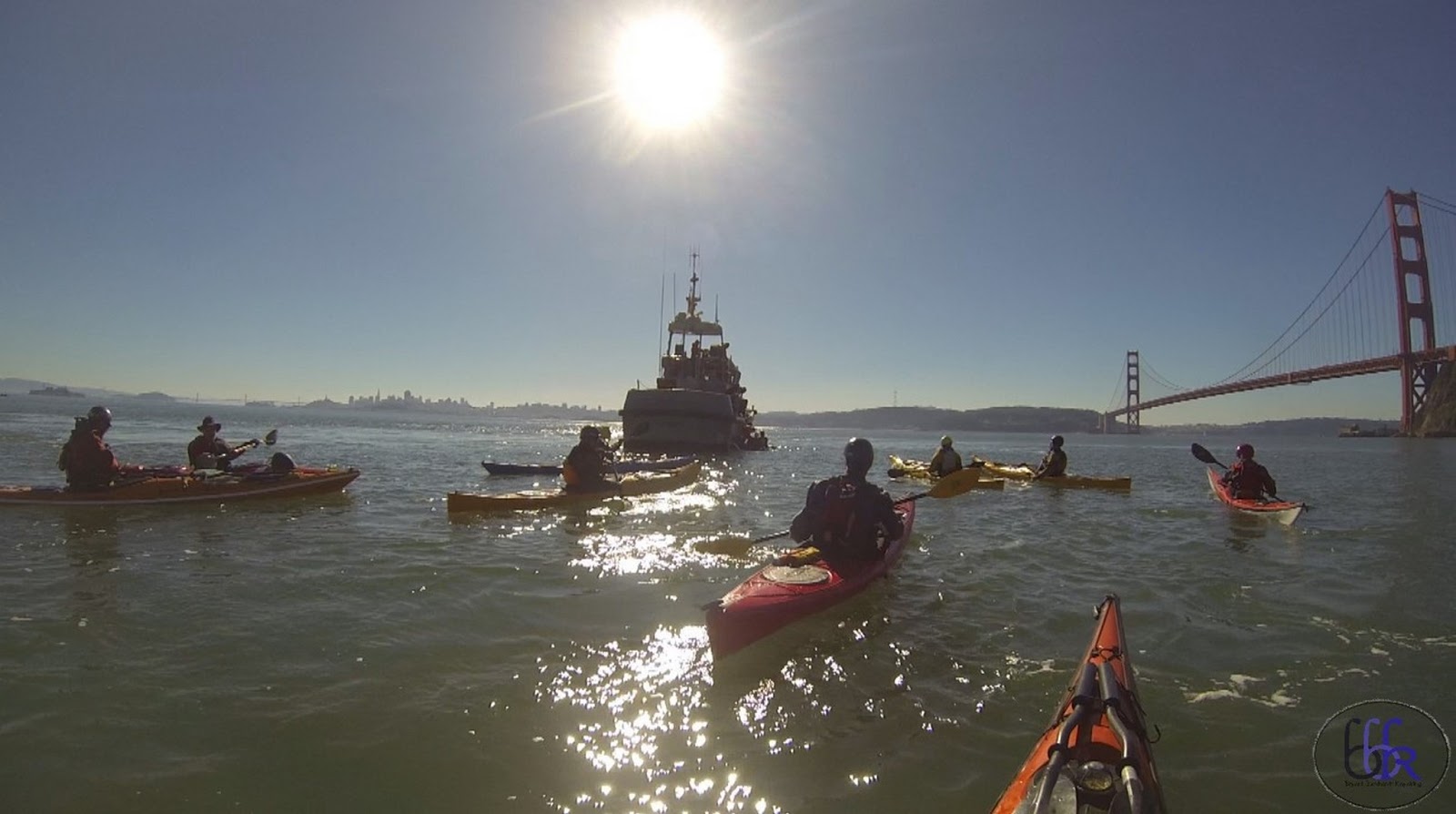
The final day was Incident Management, always a fun one. And yet another new instructor for me to meet and work with, this time Martini Ploug from Denmark who was paddling a brand new kayak model from Current Designs. Once again we worked together seamlessly and even had the treat of the Coast Guard joining us for a scenario - pulling an injured kayaker on board their forty-three foot lifeboat. The participants really appreciated the chance to actually make the radio call for help instead of pretending like you do in most classes. And even though the rescue was fairly quick and straightforward, it bought up a lot of thinking points for us to discuss afterward. A great way to round out three days of classes.

Overall it was a great weekend. The classes were fun to teach and the students always eager and ready to soak up more. But what really makes symposiums like this so special is the mood that pervades everything. It's the joy of hanging out with old friends, seeing everyone gear up for their various adventures and then catching up over a beer at the end of the day. It's learning new tricks and tools to better do my job and getting feedback that it is working. It's an immersion in the sport that makes the whole larger than the parts. While Paddle Golden Gate is going to be a biennial event (next one in 2018), I look forward to Oregon's Lumpy Waters in the fall, the ACA PaddleSports Coference here in California, and the Storm Gathering U.S. next year. And wherever you are, look around for opportunities in your neighborhood - Florida, Seattle, Great Lakes, British Columbia, Georgia, Nova Scotia, Israel, Baja, the U.K., and many more. Thanks again to California Canoe & Kayak - it takes a lot of work to make these things happen but it is so worth it!