Showing posts with label skills. Show all posts

Thursday, April 23, 2020

So There Was This Time When...

If there's anything kayakers like (almost) as much as paddling, it's telling paddling stories. Around the campfire, while sitting on the beach, or even while kayaking, we all love to share our past adventures and hear about what other people have done, be it large or small. Stories are one of the strongest bonds that tie humanity together, and while they can serve as a pleasant way to relax in good times, they also serve as a support system and a way to strengthen communities during times of stress.

As someone who's shared a lot of stories (shameless self-promotion: my kayaking memoir A PADDLER'S JOURNEY is available in paperback or ebook), I encourage everyone to take some time to write your own stories down on paper or computer. Maybe even record a video. Save your stories now while so many of us are alone and isolated and with each passing day our memories of what really happened fade a little bit more. Share them with your buddies or your local kayak club. Or save them for your kids when they get older (and can handle the truth). You'll find the process of writing or recording will force you to remember more. It will make the images clearer and the idea behind the store more forceful. It will give you more happiness in the moment and it will save some for posterity.

And as a writer and paddler I have a few pieces of advice to get the most out of your stories (caveat: feel free to ignore everything I say because what works for one person doesn't work for everyone. Find your own path).

- Think about your audience. When you're telling someone a story, that person is right in front of you and you automatically tailor what you say to who they are and how they react. Writing is different. You have to think about who you want and expect to read this. Are they a paddler? Do they know what a boof or a pourover is? Will they want to hear about a grand adventure they might never be able to do themselves or would they like to hear about something that reminds them of what they've already experienced? Do you want them to learn a little more about who you are as a person or do you want them to have a good laugh? Maybe your audience is just yourself, and you want to record your stories so you don't forget the little details later. Until you know who you are writing for it's very hard to get anything right.

- Think about the point of the story. When we're talking in real-time, we normally share a series of events that can ramble around and around, even circling back before arriving at a theme, but when you organize a story into a different medium it becomes necessary to have a point to the whole thing from the start. A thread the action carries through it. It doesn't have to be something deep and grand, but it should be something relatable. Something like: mishaps happen to the unprepared (and it's funny!); it takes courage to attempt something that will change you; friends in hard times are important. Sometimes you won't really see what your point is until you finish the story - but that's a good time to go back and start again! Which leads to the most important point:

- Editing is necessary. Everyone's first draft is pretty crappy compared to what they are capable of. You might be able to get something down on paper the first go-round that is easy to read and gets the point across, but I guarantee you will be able to improve it if you take another look and spend a little more time on it. Editing isn't everyone's favorite thing to do, and it might not be necessary if your goal is simply to record the facts, but it really is the best way to get something out of your own writing. It's when you have a chance to analyze not only what happened but how it sits in your mind and fits into the bigger picture. It allows you the creativity to change and improve how you word things. It's the core of what writing really is.


I hope you all take the time to write out your stories. Share them - you can do it here in the comments if you want. I've shared many over the years, but here's one I don't think I've told before, just to show that it doesn't have to be a long epic, it doesn't have to require near-death experiences or hilarious adventure. It just needs to connect us to the humanity in everyone.


The Best Tip

I've taught a lot of kayak classes and the particulars tend to blend together, but one sticks out not for what happened on the water but afterward. There was a mother (mid 40's) and daughter (college student) in a beginning whitewater class. Neither were great athletes or outdoor adventurers. They both did fine, as I recall, but it was clear the mother had signed them up as a bonding experience, and me and my fellow instructor were wise enough to stay out of their way and let them enjoy their time together. After our wrap-up for the two-day class the mother came over with a big smile and gave us a generous tip - more than enough for the two of them. Always nice to get some extra cash for having the sense not to work too hard.

A few minutes later, as me and my buddy were cleaning up gear, the daughter came over, a little hesitantly. She said she didn't have any money, but she was an art student and she had made a couple postcards as a class project and wanted to give each of us one. I think we all knew that a couple of river bums who lived in tiny rented rooms weren't really the art-collecting type, but we expressed our gratitude and she rushed back to her mom. I headed home and threw the card in my desk drawer.

Here's the part where you might expect me to say I still have that card. Maybe even framed it and put it up on a wall now that I have a house (and a daughter) of my own. But I don't. It's long gone. I mean, it stayed with me for half a dozen moves and it was always right there in my desk whenever I sat down to write. But years ago I needed to send a thank you note to a friend who had been there when I needed them. I knew what card to send.

You see, the card had made me feel good about myself for having helped another person feel a little joy. It only seemed proper to send it along to give someone else that same feeling of satisfaction and gratitude. And that's my tip to you: art is meant to be shared, and in so doing it honors both the giver and the receiver.


Wednesday, April 15, 2020

Kayak Lessons: The Path Less Evil

One of the best life skills you can learn through paddling, yet one many paddlers seem oblivious to, is how to manage group dynamics. You can learn a lot about this when paddling with your friends or a relatively small group of like-minded paddlers, but the best lessons come through large group paddles like those associated with a kayak club. These paddles create many opportunities similar to our experiences in society itself: how to coordinate and communicate with others, how to reach compromise, how to deal with people at different skill and knowledge levels, how to share and take turns, and even how to deal with a-holes.

Imagine the following scenario. You're on a group paddle with a dozen or more club paddlers heading down the coast. You reach a shoal between the mainland and a large island. You can cut through the rocks but it looks rough in there, or you can go around the island which will be a lot longer and at least partially into strong headwinds. Neither is an appealing choice, but the shoal would be genuinely dangerous to some of the weaker paddlers in your group - we're talking certain swims, likely boat damage, possible bodily injury. And if you go around the island the strong paddlers (including you) will likely be needed to support, and maybe even tow, the weaker ones. You come together as a group to discuss options and one guy (there's always one guy) says you should just go through the rocks. It'll be fine (he means he will be fine). And if anyone doesn't want to go that way they can go around on their own. This proclamation is met with a long pause.

It's at this point you think it all could have been avoided if people had listened when you suggested a paddle on the other side of the Bay. You all could have been paddling in a sheltered cove. Maybe taken a lunch break on a white sand beach where there's an ice cream stand and a beachfront brewery. Instead of choosing between epic disaster and a long slog, you could have been munching on a waffle cone and sipping a Guinness. But no, everyone wanted to do something else. No one listened to you then so why should you speak up now. Let them follow the fool into danger if they can't see the better choice is to go around and keep everyone safe.

And lots of folks will keep silent for various reasons. Maybe some share your distaste in the poor choices in front of you. Maybe some are just afraid - afraid of speaking up, afraid both choices will put them at risk, afraid people will think they are afraid. Maybe some really don't know how to evaluate the choices and don't know what's safe and what's not. So while it's natural to want to leave people to suffer for their own failures to make good decisions, at some point you realize what this means. It means Suzy, who brought three different delicious pies to share at the last meeting but can barely keep up with the group at best of times, will suffer, and suffer more if the group doesn't make the better choice now. It means Jim, the retired social worker who just started paddling but once gave you a lift home from a paddle after you lost your car keys, will suffer. As will some people who you don't really know but are probably decent human beings too. That's not really fair or decent.

You have the experience and abilities to know choosing the lesser of two evils means less evil, which is sometimes the best you can hope for. You know you should speak up. You should make the argument for the best course of action and you should do so determinedly and with passion to make sure the group arrives at the best decision. Not for your sake - you'll be fine no matter what - but for the sake of those who could use your help. That's what it means to be a member of a group. You look out for everyone and make the best of even the worst situations. Maybe you do it because it's the right thing to do. Maybe you do it because you've relied on others for help before and you're likely to need it again. Maybe you just do it because you really like Suzy's pie. But if we all help each other we all end up in a better place, because even the best solo paddlers got there with help from others. Paddling is a community (as is the whole world), and we look after our own (everyone).

Monday, February 10, 2020

Kayak Lessons: Beginner Rules and Developing Judgment

My daughter is now three years old and even though I try to let her learn about the world through experience and exploration I also give her some hard and fast rules: never touch the stove; don't play in the street; always tell the truth. When I taught people how to kayak I did the same: never kayak alone; always wear your lifevest; don't paddle beyond your abilities. But here's the thing, I don't follow those rules. None of the good kayakers I know follow them. Are we all a bunch of big hypocrites or are kayakers really just a bunch of three-year-olds?

The truth is: rules exist to take the place of judgment. Beginners (and toddlers) lack both the knowledge and experience to have good judgment so they need something to use instead to keep them safe until they have developed the judgment to make good decisions. Simple rules serve that purpose. But as you grow and develop in the real world you find out life is seldom simple and rules will never be able to guide you through all the complexities you will face in your paddling experience. At some point you leave the rules behind. Hopefully, by teaching people to follow rules that err on the side of safety, they won't break those rules until they are ready. It's not a perfect system but it works pretty well in kayaking (and many other areas of life).

So the questions comes in: when should we break the rules? For instance, I love to paddle solo. Some of my favorite memories and most rewarding experiences have happened on the water by myself. And while it's true that paddling alone is more dangerous than paddling with other paddlers of equal skill, not all danger is bad and more people is not always safer. Everything has risk, and judgment is knowing how to accurately assess that risk and make a good decision on how much you are willing and able to handle. I did a two-week circumnavigation of a remote island off the coast of British Columbia all alone (story here), but only have a decade of experience and serious devotion to developing the skills and judgment needed to handle such an adventure. I never felt at any significant risk given my abilities and equipment even though I encountered conditions in locations that probably would have been fatally dangerous to an entire group of intermediates.  But earlier that same year I made a bad judgment call that nearly cost me my life even though it followed good safety protocols - paddling a river I'd done many times before with a group of extremely skilled friends (story here). Everybody gets things wrong sometimes but it's extremely useful to know who commonly makes mistakes and why - so you can avoid them.

Studies have shown that adventure athletes are most likely to make serious mistakes of judgment at two different times in their careers. Not beginners. They tend to be pretty safe, following the rules because they know they don't know any better. But once they become new intermediates with a little bit of time and experience under their belt they often overestimate their own knowledge and skill, use their supposed judgment in a new situation, and get into trouble. It's the group that has paddled on several lakes deciding they are ready for a protected ocean bay without knowing what tidal currents are all about. It's the class III whitewater kayaker who thinks they can handle a new class III river because the rating is the same without bothering to understand how committing the run is or what type of hazards exist. They mistake their very limited knowledge and experience as a good basis for using judgment to replace the rules when they are not ready, or they misinterpret the rules because they don't use their common sense to carefully apply them.

We make this mistake so often in life as well: assuming our very limited knowledge and experience gives us good judgment when in reality we are simply clueless to the larger realities that exist and contradict our own perceptions. I see white people claim that racism isn't a problem anymore because they don't see it (reality); people with no economics training claim our economy must be doing well because the stock market is rising (reality); all kinds of folks believing gender identity is the same as biological sex because we were taught that as kids (reality). Most of us have a lot of experiences in our lives but we fail to grasp how the big, wide world is different than our little corner. We are fortunate in that we have the ability to learn from others' experiences by reading and listening to people different from ourselves and those who have studied widely. Sadly, we too often rely on our own limited realities instead of seeking out knowledge that would greatly improve our judgments. We could become experts, or at least listen to those who are.

But that brings up the other people most likely to make lethal mistakes: the experts. Not because they are pushing the limits of risk on new and dangerous adventures. No, experts are most likely to get killed doing something they've done before - a familiar run or known location. Their mistake is they use their past judgment - I've paddled this river before and survived - instead of applying their full judgment on the current situation. Maybe the river is at a higher level, maybe the weather conditions are different, maybe they are not performing at the same level they used to. Judgment is only good if it is constantly questioning itself and using all knowledge and experience to evaluate current conditions.

This happens often in academic fields. While it is the nature of scientific discovery to always be questioning itself, which does lead to advancement and improvement, it is part of human nature for the individual scientist to lag behind. As someone with an economics degree from twenty-five years ago, I can safely assert that many things I learned in college are now inaccurate based on studies and findings that have come out since. But I regularly see experts and pundits in the media quoting the same historical ideas as if the world and our knowledge haven't changed. What my training did give me, what anyone can apply, is the format to approach new information and the tools to incorporate more facts into my evaluation of what is good. Raising wages doesn't necessarily hurt employment (reality). GDP growth is not the same as a prosperous and healthy society (reality). Just because you knew something was true before does not mean it is now, and basing your decisions off old knowledge is as reckless as basing them off no knowledge.

Kayaking, like life, is complicated. Most of us are past the stage where we should have to depend on blindly following rules we learned long ago. We aren't three-year-olds anymore. But we need to develop and refine our judgment instead of assuming the simple act of growing older is enough to imbue us with wisdom. Maturation only happens through careful reflection upon our own experiences and listening to and understanding the experiences of others. The best judgment is always improving and the truest bravery is admitting what you don't know.


Wednesday, March 2, 2016

Feeling the Love at Paddle Golden Gate

It's been a couple weeks since the event but I've been on vacation and just found the time to sort through pictures and put some thoughts together. Paddle Golden Gate is an amazing sea kayak symposium put on by my old employer California Canoe & Kayak and my good friend Sean Morley. It's functionally the heir to the Golden Gate Sea Kayak Symposium which was the same basic event run by mostly the same people but under different auspices. Whatever you call it, the event is a gathering of some of the best instructors in the world, some of the most eager and dedicated students, in one of the most spectacular urban paddling environments at the base of the Golden Gate Bridge.

I've taught at the event since the first one back in 2009, and going back each year is like a class reunion - but with only the good people you used to hang out with, none of the annoying folks who you always tried to avoid. Since I moved to the Mendocino Coast a few years ago I teach less often and see my fellow instructors even less frequently, so it was great when I arrived at the Marin Headlands Hostel the night before classes started and I was stopped to get a hug or handshake five times before I could make it the twenty feet to check in and register. Some folks I hadn't seen in months, some in years, but everyone was happy and I spent the next two hours catching up with people before retiring to a surprisingly quiet room (dorm sleeping is all fine and dandy until you get one loud snorer in there).

The first day I got to lead a tour to Angel Island with Sean Finigan. Sean's from my old stomping grounds in Sacramento and we've paddled together a few times but never taught together. We had a class full of folks who, more than anything else, wanted to enjoy a day paddling on San Francisco Bay, most of them for the first time. We had to fight against the current and make a hard ferry across Raccoon Strait, but we were rewarded with a sunny, relaxing lunch in the middle of the Bay - California winter can be grand! After we rode the current back home we had a nice meal at the yacht club and more catching up with old friends and new. Couldn't have been easier.

Day two brought even warmer and sunnier weather, if that was possible. I was scheduled to lead one section of the combat rolling class and traveling instructor extraordinaire Ben Lawry another. We joined forces in the morning to assess and divide up the students which lead to groups divided out by interest and ability, which allowed each of us to really address the needs of our students and everyone seemed to get what they needed out of the day. I got help from another new instructor - Mike Kowalsky. Sometimes it can be a little awkward working with someone you don't know - you step on each other's words, use different sequencing or progressions, etc. - but the whole day went smooth, trading off topics and letting one idea flow into the next. Another great day in the books.

The Saturday evening presentation was at the Bay Model (a very cool place in it's own right). More great food provided by CCK, free beer provided by Ninkasi, and an amazing slideshow and story from Jaime Sharp on his circumnavigation of Svalbard. Brief summary: lots of icebergs, polar bears, and stunning beauty.

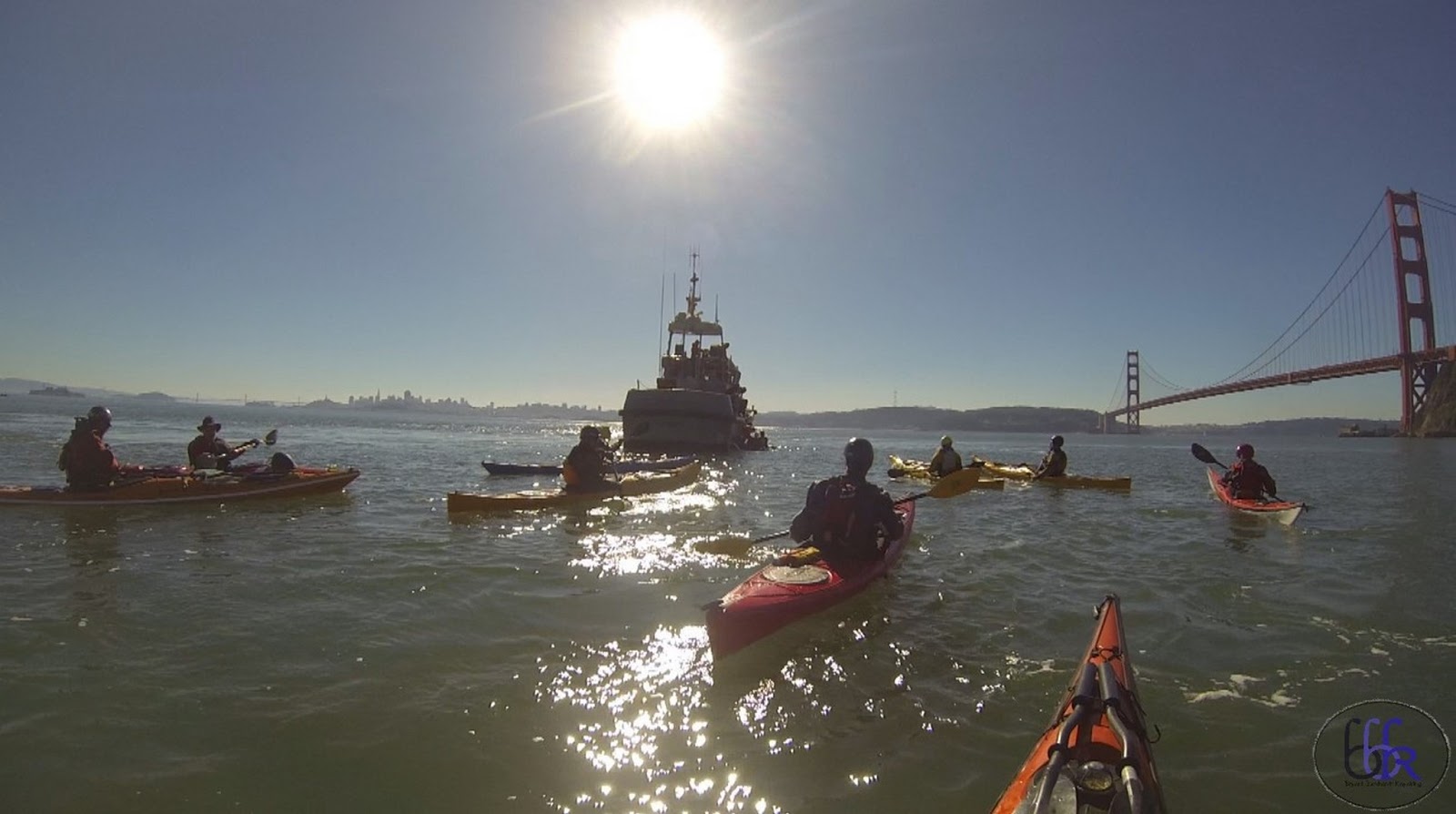
The final day was Incident Management, always a fun one. And yet another new instructor for me to meet and work with, this time Martini Ploug from Denmark who was paddling a brand new kayak model from Current Designs. Once again we worked together seamlessly and even had the treat of the Coast Guard joining us for a scenario - pulling an injured kayaker on board their forty-three foot lifeboat. The participants really appreciated the chance to actually make the radio call for help instead of pretending like you do in most classes. And even though the rescue was fairly quick and straightforward, it bought up a lot of thinking points for us to discuss afterward. A great way to round out three days of classes.

Overall it was a great weekend. The classes were fun to teach and the students always eager and ready to soak up more. But what really makes symposiums like this so special is the mood that pervades everything. It's the joy of hanging out with old friends, seeing everyone gear up for their various adventures and then catching up over a beer at the end of the day. It's learning new tricks and tools to better do my job and getting feedback that it is working. It's an immersion in the sport that makes the whole larger than the parts. While Paddle Golden Gate is going to be a biennial event (next one in 2018), I look forward to Oregon's Lumpy Waters in the fall, the ACA PaddleSports Coference here in California, and the Storm Gathering U.S. next year. And wherever you are, look around for opportunities in your neighborhood - Florida, Seattle, Great Lakes, British Columbia, Georgia, Nova Scotia, Israel, Baja, the U.K., and many more. Thanks again to California Canoe & Kayak - it takes a lot of work to make these things happen but it is so worth it!


Monday, January 18, 2016

Cold Water Vertigo

In a couple of weeks I'll be teaching at Paddle Golden Gate (renamed from the Golden Gate Sea Kayak Symposium). One of my courses will be on combat rolling, so as I was working on my syllabus I figured it would probably be a good thing to get in some rolling practice of my own. I've haven't been paddling that much lately and when I've gone out it's been for fun, not work. And just like any long-time paddler, us instructors can get a little lazy on skill practice - when it's cold out and you don't have to flip over, why bother? So I hadn't done much rolling, especially not in cold water. Time to make up for my laziness.

I went out on the river - the surf was big and nasty - and planned to get in some quick rolls and head back home for some housework and then a hike (getting in shape for a backpacking trip - there's always something to get back in shape for). I wore my drysuit, put on a nice neoprene skull cap under my helmet, even had my pogies on. The weather was mid-50's (this is California, after all) and the water was several degrees colder than that. Not the most frigid conditions for paddling, but cold nonetheless.

I paddled upriver a ways to warm and felt quite toasty before I started some bracing to loosen up and get my face wet. The cold water refreshed me and gave me the usual doubts - did I really need to go over? I did, so I rolled. My left side rolls felt fine. I'm right-handed and learned my right side first, but my left side has always been smoother and easier. I never try to muscle it. My right side worked but didn't feel as smooth. I was fighting it and wasn't sure exactly why it wasn't working so well. I kept rolling, mostly the right, occasionally the left. Over the course of half an ourh I probably did thirty or forty rolls, with some paddling breaks to stay warm.

While I was intent on smoothing out my technique I didn't pay enough attention to my location. I drifted a bit into the shallows and on my next roll attempt I hit the mud with my paddle (side note - diving blade angle not good). I struggled to pull the blade free of the mud and by the time it came clear I was low on air and quite discombobulated. I instinctively set up for a roll on my right side but I had no clue where the surface was and my roll failed completely. I pulled my skirt and quickly wet exited for some air.

In eighteen inches of water it should have been easy to stand, but when I tried to get to my feet I fell right back over. I held on to my boat and anchored a foot in the mud so I wouldn't drift in the mild current. The world continued to spin and after a minute I gave up on the notion of walking and crawled my boat into shore. A couple minutes of rest on solid ground returned the steadiness of the horizon and I was fine.

I've always known cold water on the inner ear could induce vertigo. It primarily happens when cold water gets in one ear and not the other - something facilitated by wearing a hood and twisting yourself upside down underwater. But I've never experienced it myself. I think it's because I don't normally spend that much time upside down. Quite disconcerting.

It wasn't a danger in my case - even though I was by myself, I was smart enough to practice in a protected place near shore. But if it had happened while out in the wild it would have been a different story. The good news about the effect is that it generally goes away once the water in the ears warms up - so even if you're floating in the swell it should subside after several minutes. But that means you have to be prepared to spend several minutes in the water; another reason to dress for immersion.

It's good to have confidence in your skills. It's good to have a combat roll that you believe will never fail. It's still necessary to have backup. It's still smart to practice and keep your experience fresh. Our bodies fail us sometimes, often in new ways we didn't expect, often through no fault of our own. Cold water vertigo seems to become more common as you age - and we're all getting older.

The solution is simple: earplugs. I've misplaced my own or I would have worn them. Not only does it limit the chance of cold water vertigo, it helps to protect the ear from surfer's ear, a much more serious and long-term problem. I'm going out to new earplugs now :)

Friday, January 1, 2016

Kayak Meme Machine 2

Just for the fun of it, I thought I'd take some of my favorite photos and turn them into memes. As near as I can tell, the requirements for a good meme are a square cropped picture, Impact font, and no limitation to facts or common sense. So I'm going to throw a bunch out and maybe they'll spread through the interwebs and bring a little light in the gloom of night. Or at least a chuckle from those who understand. And there are more collections of my Memes: post 1post 3post 4


For the edification of my blog readers, this picture was taken in 2011 at Oceanside, OR. The paddler on the wave is Sean Morley, in the just released P&H Delphin. It was the day after the Lumpy Waters Symposium, the traditional 'Coaches Play Day'. The waves were big, but mostly friendly. A larger set did come in and catch a few of us inside, with one imploded hatch and interesting rescue to follow. Good times.

Monday, December 14, 2015

The Kayak Meme Machine

It seems like life has been heavy lately. Not just for me, but for the world in general. Terrorist attacks, vitriolic political debates, short and dark days of winter. I thought I'd lighten things up, at least for me, but taking on a fun little project that combines a few of my favorite things: writing, photography, kayaking, even a little graphic design. And there are more collections of my Memes: post 2post 3post 4


I thought I'd take some of my favorite photos and turn them into memes. As near as I can tell, the requirements for a good meme are a square cropped picture, Impact font, and no limitation to facts or common sense. So I'm going to throw a bunch out and maybe they'll spread through the interwebs and bring a little light in the gloom of night. Or at least a chuckle from those who understand.


If you have any photos you'll like to contribute, just send them in. Or if you have a better caption for my pictures just let me know. Let's have a little fun with life even if we're stuck here on dry land.


Saturday, December 5, 2015

A Paddler's Journey for the Holidays!

My kayaking memoir, A Paddler's Journey, has been out for a few months now and I can't tell you how great it is to hear from folks who have read and enjoyed it. When I showed up at Lumpy one of the participants searched me out to tell that her friend had read the book all the way through in one sitting and told her she had to get it. She wasn't reading quite as fast but was half-way through and loving it. A number of paddlers have expressed a little surprise that someone with my experience goes through the same issues: doubt, fear, frustration, failure. But that's kind of the point - the details may be different, the trips a little grander and rivers a littler harder, but we all really experience the same things. I think non-paddlers will get just as much out of it for the very same reasons.

So in light of the holidays, and hoping people might want to share with their non-paddling friends a little window in the world of kayaking, I'm putting the book on sale.  If you purchase it through the CreateSpace site and use the code XUW6M6ZV you'll get $3.00 off the cover price. That makes it only $9.99!


And if you want a signed copy you can order that through my website. You can even tell me what you want on the inscription and have me mail it directly to someone special as a gift. I have limited stock on hand so first come first serve for Christmas gifts. You'll need to order by 12/15/15 in order to make sure it gets there in time. And if you order in December I'll even through in a free copy of my Paddle California DVD, highlighting some of the best kayaking our wonderful state has to offer.

(with free Paddle California DVD)


The digital version is temporarily only available at Amazon and at $2.99 you don't really need a sale price to afford it :)


And if you've already read the book, let me know what you thought - I love to get feedback. You can always leave a comment, or if you want to share your thoughts with the rest of the world, consider writing a quick review. (Reviews also help drive Amazon search engines, so just by leaving one you'll help other people find the book)


And for those who missed it the first time, here's the trailer if you want more info on the book itself:


Saturday, November 28, 2015

5 Life Lessons Learned Through Kayaking

I've learned a lot about kayaking over the years, but just as importantly, I've learned a lot from kayaking. The river, in particular, teaches us many things about overcoming adversity, making wise decisions, and staying humble. Here are five principles I've learned  over my twenty years of whitewater kayaking that I try to apply to my life every day.

1. You have to commit if you want to improve

If you only dabble in the sport, you might find it quite enjoyable, but the path to improvement is paved with consistent effort and dedication. There are no shortcuts around time in the boat. During the spring runoff of my first season, I boated seventeen out of eighteen weekends. I paddled with people better than me and listened to what they said. I worked on skills, I did drills, I took some beatings. But by the end of the snowmelt I paddled class four consistently and never looked back. Nothing says you have to be a class V kayaker to enjoy the sport, but there is a steep learning curve to get to a basic level of competency, and if you don't get there chances are you won't keep kayaking for long.

There are a lot of different things you can do with your life, but if you don't put much effort into any single area, you most likely won't get very far. We get more out of long-term relationships than transitory ones. We learn more, contribute more, and generally make more money and find success when we commit to a career path. You can change and adapt, maybe even start over in something completely new, but at the start you need to give it everything you've got if you want to get the most out of it. Life requires more than dabbling.

2. If you mess up, you can't just quit

Everyone gets off line once in a while. You miss your boof, you misjudge the current, you get flipped over. In the middle of a rapid you can't simply stop and get off. You roll up. If that doesn't work, you try again. You quickly take stock of the situation you're in now and come up with a plan to get back to where you wanted to be, or you find a new path to the bottom.The river doesn't quit so neither can you.

No one's life goes perfectly according to plan. We lose jobs, we say the wrong things at the wrong time, we make bad choices and suffer bad luck. But complaining about it doesn't get you anywhere. Neither does beating yourself up. The way to get ahead is to look forward and figure out how to go there, to make the best of whatever situation you've landed in. You keep fighting. And bonus points if you can learn not to mess up the same way again in the future.

3. Everyone is on their own path; enjoy yours

Expedition kayakers have more air miles but they don't have more fun. Slalom kayakers have more skills but they don't get the best scenery. Playboaters learn to enjoy themselves without going anywhere. There are lots of different ways to kayak the river and each one is as valid as the others. Some people paddle class V in their first season; some stop at class III for their entire career. We all end up around the campfire at the end of the day swapping stories and sharing laughter.

Success is such a vague word, but so many people want to define it explicitly. Even worse, they let others define it for them. Chasing someone else's goal is never going to provide satisfaction. If you take a little time to decide what's important to you, what you want to get out of life, it becomes much easier to see the path to get there. Don't be jealous of someone ahead of you - they might be headed in the other direction. Don't worry if someone walks faster - they might have farther to go. Stop comparing yourself to others and you'll not only find more joy in your own successes but you'll be better at helping others achieve theirs.

4. The opportunities you skip are what you regret

Some rivers only run in big rains. Some require permits that are hard to get. Still others cost a lot of money and time. They're always worth it.When we look back on our paddling careers we remember the once-in-a-lifetime dam spill, not the day of work we skipped to go paddling. Eventually we make enough money that we don't even notice what we spent on that Grand Canyon trip. The more stories we have to tell, the more time we've spent with our paddling buddies, the bigger our smiles. What we regret is the river we never ran.

Life is about experiences, not things. Everyone knows this. Every old person says so. Yet we constantly make choices in our daily life that prioritize material goods over people and activities. We work hard now with the justification that it will lead to a better future. While it's fine to be responsible, it's good to build a nest egg and lay the groundwork for a successful life, it doesn't have to be at the expense of living in the moment. Take time off to spend with your kids. Blow the budget on a vacation to see old friends. And if you ever get a chance to go on a multi-week river trip - take it!

5. Who you go with is more important than where you go

A lot of people kayak for the excitement. Or maybe for the scenery. Or the physical challenge, the mental challenge, or just because they like water splashed in their face. But we all love the community. We make life-long friends on the river, even if we just met them at the put-in that morning. We bond faster, deeper, and more meaningfully through our shared adventures. And in the end that's what makes kayaking great. I've had just as much fun on the local class II run with good friends as I've had on remote wilderness trips. I've had bad experiences on beautiful rivers when the group cohesion fell apart. The ultimate paddling experiences start and end with people whose company you enjoy and who you willingly trust your life to.

The same is true with work. The same is true with friendship. It's easy to fall in with a random group of people and even easier to let people stay in your life who shouldn't be there. Kayaking is a crucible that grinds away the outer shell and reveals who people really are, which makes it easier to choose who you want to hang with. But we can do the same in life, we just have to look a little harder. Pay attention to what is said and left unsaid. Observe how they handle themselves in stressful situations. Trust our instincts. Most importantly, we do have the power to choose who we want to spend our time with and who is a negative influence that should be avoided. Everything we do, every trip we take or day spent behind the desk, is either lessened or uplifted who we share it with. Choose wisely.


Of course, I've learned a lot more from kayaking over the years. Too many things to fit into a simple list, and I'm sure as I continue to paddle I'll learn many more. But these are five truths I remind myself of on a daily basis. How about you? What has kayaking taught you?

Sunday, September 20, 2015

Lumpy Waters coming up!

I'm getting really excited about headed back to Oregon next month for one of the great kayak symposiums out there - Lumpy Waters. Also really looking forward to seeing good friends, often for the one and only time of the year. I'm sure I'll have some pictures and video to share afterwards, but in the meantime, here's a link to my write-up from my first time at Lumpy - hard to believe it was five years ago...

Lumpy Waters and Sunny Skies

Thursday, September 10, 2015

River vs. Ocean Rolling Mentality

I was kayak surfing at Big River the other day, and on my paddle out I saw a big one coming and decided to turn and take it in. My takeoff was late but I managed to find the shoulder and start my run. That's when it hit me.

One of the features of that location is the near vertical cliff wall on one side of the river mouth. It often creates reflected waves that come at ninety degrees to the wave you're riding. The reflection comes down the line like a pulse of energy, and just as my ride started to crumble the pulse hit me and launched me into the air. I landed vertical, nose down, and drove deep into the building foam pile.

I tried to balance myself and even put my paddle out for support with the hope I could pop back up. My boat (a Necky Jive) is too long to loop even if I actually knew how to loop. But I thought if I could hold position my buoyancy would shoot me up and out and I'd at least be on the surface. That's when the rest of the wave collapsed.

The freight train flipped me over and drove me deep under. Now I was upside down with a pile of water on top and nothing but twisting, violent currents surrounding me. This is the spot where many ocean kayakers will wait for the wave to pass and then roll up. Here's why that's a bad thing.

While you're waiting, other waves are coming. The longer you wait to roll up the closer the next wave will be to hitting you. To fully take advantage of the lull between waves you need to be upright and paddling. It's great to be comfortable upside down, to think clearly and maintain your composure and awareness. But physically you can't accomplish anything. You're there to kayak and you do that upright. Take a lesson from river kayakers.

On the river, waves don't pass. They stick around. Holes can be even worse. It's possible you'll flush out and have a calm pool to roll up in, but you can't count on it. Being upside down is dangerous for the fact you might not go anywhere and for the fact you might go somewhere you don't want. It's essential if you're paddling hard whitewater that you roll up right away and get on with your paddling.

It's a normal progressioin in rolling on the river to wait. You get flipped in class II and there's probably a relatively calm patch of water after every feature. There aren't sticky holes. But as you move into class III, and definitely class IV, the rapids get longer, there are more features, and you can't always hang on until the flat part to roll. So you learn to roll in the mess.

Photo: Darin McQuoid
The first key point is simply the mentality. There's no thought of waiting. If you're upside down you start rolling up. Ideally you don't even worry about a set-up position. From wherever you find yourself, tucked or leaning back, however your paddle is oriented, whichever side it's on, you simply roll from there. If you can use the momentum of the water to help you all the better.

That's the goal and it takes practice - the second key point. Everyone starts out rolling in flat water so it's natural to get used to that. And it's good to practice in the pool. But get your approach away from setting up and finding the right position. Stop looking for the surface. Change your understanding of rolling from a specific sequence of motions to a general concept of using your paddle and your body to bring the boat underneath you. Practice it from every position. Practice it in the current. Throw yourself in a hole or the foam pile and practice it there. There's a reason why playboaters have the best rolls - they flip themselves over in dynamic water on purpose all the time.

This is what you do if you want to paddle difficult whitewater. It's also what you need if you want to paddle rough water in the ocean. Too many sea kayakers seem content with the wait and roll approach. Their rolls depend upon specific techniques, often ones that bring them up lying on the back deck in unstable positions. That's fine to start, but don't stop there and let it become the habit. Learn some different rolls, work on both sides, and get really comfortable being upside down. Make your goal right away to be able to roll in the chaos and come up ready for more. It may take time and practice to get there, but you'll be a better paddler and a lot safer on the open ocean.

I don't know how I rolled up from my wipeout at Big River. It was all very confusing, but I felt water pull on a paddle blade and I anchored myself on that blade and used my hips to bring my boat underneath me. I felt the air and I was up - facing backwards and still in the middle of the foam pile. One stroke in the smooth water behind the pile and I was free. I saw the next, larger wave coming and paddled to the side to avoid the hit. After making my way outside, I picked my waves a little more carefully and caught better rides without needing to roll again. That's how it should be.


Sunday, August 23, 2015

The Art of Sea Kayaking: Awareness/Judgment


This is part of a series of posts covering what it takes to paddle on the open ocean, exposed to swell and away from easy landings. I'll discuss the techniques and ideas I feel are important to understand in order to safely paddle in such a dynamic environment with the focus on how to approach thing instead of simply how to do things. While my intention is to help guide folks who are newer to the sport and possibly neophytes on the ocean, I hope some of the wisdom I share gives even the most seasoned paddler more to think about. This is not meant to teach any specific skills, but rather to inform people on what they should be learning and give some suggestions for going about it. Many of these things are covered in typical classes (some are not), and I highly encourage instruction from a skilled teacher. But I also know many paddlers learn through experience - properly so - and hope these concepts will lead to better learning experiences.

There's a sequence to these posts for a reason, so if something seems unfamiliar try starting at the beginning. Make sure to read the disclaimers and warnings in Part 1: Introduction. And feel free to ask any questions or share your own thoughts in the comments.

Part 2: Technique
Part 3: Rescues and Rolling
Part 4: Surf Zone
Part 5: Forecasts
Part 6: 
Awareness/Judgment
Part 7: Seamanship
Part 8: Working With the Water
Part 9: Rock Gardening


Awareness/Judgment

The Theory

To see what you want to see, you have to know what you’re looking for. That’s a little trickier than it sounds.

When paddling along a coast there are some obvious things to look for. The beautiful scenery, the ocean waves, your paddling companions. But what are you looking out for? What are the important signs of possible danger? What should you pay attention to and  what do you need to anticipate. How do you spend all your time being aware of hazards and still enjoy yourself?

We all want to have fun when we paddle – that’s the whole point – but in a dynamic and possibly dangerous environment like the open coast you also need to constantly be watching for changes that might put you at risk. You need to know what’s happening, what could happen, and what you and your partners can do to deal with whatever does happen. It’s a general concept, lacking in specifics by its very nature, but it is something you can practice and improve.

You have to be aware, and awareness needs to be a continuous and fluid thing. If you’re trying to follow a checklist or a bunch of rules, you won’t do it as often and you’ll miss out on the beauty that’s around you. Awareness is a state of mind that you have to work at reaching, rather like meditation. Not only does it make you a safer boater but it lets you get more out of your paddling experiences.

In theory you’re paying attention to everyone and everything. That can seem overwhelming. Start by making sure you’re not focused on any one thing. Many people paddle just watching the boat in front of them. Or maybe the birds. Or maybe they get lost in a great conversation with the person next to them. You really can’t afford to do that on the ocean. Always keep looking around. Count the paddlers in your group. Look behind. Look up. Make sure to change your focus frequently and you’ll actually appreciate a lot more of the world around you as well and increase your awareness of risks.

The goal is to see the bad things coming before they arrive. You don’t want to all of a sudden realize the wind is very strong or that wave is very close. The truth is most disasters unfold slowly on the ocean, over a matter of hours. People get cold, conditions deteriorate, the group gets farther and farther from safety. These things start as small problems and grow, but if you see what’s happening when it’s still very manageable you can make small corrections that change the trajectory of the outing. Ask the person next to you if they’re warm enough. Figure out why your boat keeps wanting to go to the left. Stay close to shore if it feels like the skies are darkening. You have to see the problem building in order to cut it off while it’s small. Information is your friend.  


Judgment is what you do with the information you are now aware of. It’s deciding a course of action, a route through the rocks or where to position yourself in the group. Whether to press on or turn back. It’s not always about making the safe choice – the safest thing is to never be out there – but about understanding the consequences of your actions and making sure you can handle the possible outcomes. It’s about balancing risk and reward, exposure and experience.

Without good information you can’t make a good decision. And out on the coast you are constantly making decisions, which is why you have to always be aware. The key is to start making those decisions with conscious thought instead of letting happenstance and habit dictate your actions. Gather the information you need by observing the physical world and consulting your own experience. Don’t be afraid to ask questions and get feedback from your companions, those who might know more and even those who definitely know less. Everyone is a part of the equation.

The hardest part to this for beginners is that they start out letting someone else make their judgments for them. It’s natural. Your instructor has more experience and knowledge so you let them decide. You join a club and head out on a group paddle with a strong leader. You go out with your more experienced friend who got you into the sport in the first place. It’s not only easier to let someone else decide, it allows you to pretend the risk doesn’t even exist. It takes away your responsibility and who wants responsibility when you’re having fun? Eventually that attitude will hold you back and put yourself and others at risk. So start learning how to handle things yourself right from the start.

Start by asking your instructor why they made that decision. Ask them what they see when they look out at the surf. Check your own compass while you’re following the leader. Try to guess if the group will go inside or outside that rock (and guess who’s going do the opposite of everyone else). Even if the decision is up to someone else, make up your own mind and see if it agrees with them. If not, start a discussion (not an argument) to find out why other folks came to a different conclusion. Paddle with your betters but aspire to be their equal. Recognize it takes time and effort to get there.

You don’t need to rely on the ‘experts’. Sometimes very skilled paddlers still have bad judgment. Sometimes they just have a greater comfort with risk. Sometimes they’re not around. If you’re paddling with peers, or maybe you’re the leader of the group, still ask for help. More people means more information, and good leaders take it all in. Ultimately someone needs to make a decision – non-decisions left up to the vagaries of groupthink are almost always bad. Consensus is fine as long as it’s spelled out. You need to know what others are thinking and feeling if you, or anyone, wants to make a good decision for a group. Ultimately someone has to speak the plan or lead the way.

The good paddlers are making these informed decisions constantly. They also keep a flexible frame of mind. Goal-oriented activities are the nemesis of good judgment. If you’re set on launching from a certain beach, traveling a certain distance before calling it a day, or feel a need to prove yourself to your peers, your judgment is likely to be impaired. It is possible to set and reach goals and retain good judgment, but it makes it harder. It helps to build up your judgmental experience by taking the pressure off yourself. Let your sense of what is safe and reasonable decide what your goal should be, not the other way around. Be willing to miss out on a good experience in order to avoid a really bad one.

The theory is to be aware and make conservative decisions. By having that as your goal you are already steps ahead of the pack. Here are some things you can do to get further ahead. 

Practice

Start with the big things. You should already know the forecast for the weather (see the previous post in this series), but you need to pay attention to how the weather is changing. Pay attention to the clouds in the sky – puffy white clouds are pretty but a line of grey clouds means something else. Watch the sea state – not only will you see if it’s getting windier but you’ll have a better chance at spotting whale spouts or sea lions popping up for a visit. Feel the swells pass under you – you’ll connect with the ocean and improve your paddling while also learning the pattern of sets for the day.

That same mode of thought applies to deciding where to go. When you look at the rocks, notice how the waves roll over them or deflect around them. It’s fascinating to see the interaction of water and stone, and also very informative to see how different size sets behave differently. Just like in the surf zone, patience is your friend as you evaluate ocean features.

Feel the wind on your face when you look around to pinpoint the direction it’s coming from. Look at the sky in that direction since it’s headed your way. Count the whitecaps you see – are their more where you’re headed? That means it’s windier over there.

Outside of the physical environment, the most important thing to keep watching are your friends. Where are they going? What are they doing? Are they all still here and upright? Checking in early allows you easy opportunities to avoid future difficulties. Offer that chilly person an extra warm hat or a snickers bar before they get hypothermic. Stop and fix the footpeg instead of constantly doing sweep strokes until your arm tires out. Notice your buddy’s stern is riding low and realize the hatch cover isn’t on tight while you’re still close enough to shore to make it back if you can’t fix it on the water. Some things are hard to see but if you ask a few questions you’ll learn a lot. And what you didn’t notice someone else might have. The strength of any group is their combined skills, awareness included.

Aside from the physical, learn to consider the psychological – it’s an important part of group dynamics and the key to smoothly functioning paddle trips. Is everyone comfortable with the route and conditions? Does everyone have the skills to deal with what might be faced? Communication is the key to group decision-making and getting everyone involved early is necessary to facilitate making the tough calls when things go sideways. In the end, someone needs to speak the plan and you'll get more agreement (and a better plan) if everyone has contributed and feels free to share their thoughts.

There are many ways to arrive at a decision. Some people suggest formulas, like the bulls-eye method developed by Body Boat Blade, which is good when making big decisions like deciding whether or not to launch (brief overview here). But you won’t constantly be pulling out a chart every time you need to decide whether to go through the rocks or around them, or whether to paddle next to Bob or up front with Mary. I think you need something a little simpler and quicker for the majority of small decisions that get made every time out on the water.

The way I like to approach things is with a focus on PROBABILITY and CONSEQUENCE. Whenever I consider what could go wrong I also give it a likelihood. I could get attacked by a Great White at any time, but I know the odds are very remote so I don’t do much to adjust my behavior (though I don’t do rescue practice next to a rookery in the fall). A large set coming in after a lull is much more likely. If I paddle behind that rock how often does a wave big enough to break come by? Is it common for winds to pick up in the afternoon (yes!)? I use my past experience to estimate the likelihood of typical problems on the water and make my best guess as to what could happen. It isn’t perfect, but it isn’t random.

Once aware of what can happen and how likely it is, you need to consider how bad it will be. If I do get hit by that big wave, would I be able to brace and ride it out or does it slam into more rocks? If something is likely to flip me, will I be able to roll up? If I end up swimming, how cold is the water, how warm am I dressed, how far would I have to go? If Jimmy gets tired or someone blows out a shoulder, do we have enough strong paddlers to tow them to safety? Do we have communication gear to call for help? While a lot can go wrong, most of it can be dealt with as long as you have the proper equipment and training. So when I see a risk I don’t have to automatically avoid it. I can choose to take it if I feel the reward is worth it and the consequences are acceptable.

I don’t have a magic formula, but if there’s a high risk of something going wrong I still might try it if the negative outcome isn’t all that bad. Swimming into the beach on a sunny day certainly won’t ruin a surf session. But I stay away from low risk situations if the outcome is something I really don’t want to deal with, even if it’s unlikely. I stay away from rocks if I’m in my friend’s new composite kayak. I don’t go around that point if I know a squall could blow the group out to sea and it’s already getting late in the day. If it’s just me and my wife I’m much more conservative in my play, but with a larger group of skilled paddlers I know there are simply more resources to deal with whatever happens.


You can practice this judgment in retrospect. While that includes looking at situations that went wrong, it’s just as important to review when things went right. Too many people assume that a lack of disaster indicates good decisions were made. That’s simply not true. If you survived the first round of Russian roulette, it hardly proves your thought process is sound and definitely doesn’t suggest the second round will be equally as successful.

After every paddle take some time to consider the choices you made and think about how things turned out. Did you turn back in time? Was your route a good one? Did everyone have fun on the trip? Do you realize now that you would have been in real trouble if a large set came while you were exploring that cave? Reflection is the key to growth.

If you can, include others in the review. A fine time to do this is with a beer in your hand after a large and satisfying meal (on the other hand, a bad time to do this is after several beers and one too many roadside tacos). It doesn’t have to be formal or structured, but pay attention to those who have more experience and listen to those who don’t say much. We all have war stories to share and most of them have a useful lesson buried in there somewhere. It’s fun and educational at the same time. 

Conclusion

 You can normally spot the paddlers who are aware by watching their head. It swivels. They take in the whole 360. They’re the ones who saw the harbor porpoise, noticed Frank has a new paddle, and found the coolest slot to run. They’re having the most fun and make you want to paddle with them. That’s the paddler you want to be.

The ones who always leave the decisions to others. The ones who are up for anything but often end up needing help. The ones who are surprised by what the ocean brings. Those are the paddlers you want to avoid.

It’s an attitude. A choice. Being aware and making good judgments are skills to develop and practice. They go right along with a solid roll and the ability to back surf; with helping others carry boats and having extra chocolate at the lunch break. All things very much needed in this sport.